KZ2101. Jack Full-on thought Moonbeam was talking about a radio station the first time he heard her mention KZ2101. He was on the bridge of the Cyster Judy, the best pirate vessel from Mars outward. He and his crew were discussing exactly how they were going to get their WaterMarks back. A man named Rankor Shim stole them all. Jack very much wanted to speak with him about that. That was when First Mate Moonbeam had mentioned KZ2101, the asteroid.
“Come on, Jack, you’ve never heard of KZ? You’re a pirate, for criminy’s sake,” chided Violet from the comm console, “How am I ever going to live this down?”
“She’s right, Jack, that’s pretty lame. I’ve known about KZ since grade school. They have the finest brothel in the solar system,” said Schwag, looking up from his porno mag.
“Who asked you?” Jack retorted. “Don’t you have work to do?”
“I’m top gunner, Jack. Are we in a battle? No? All right, then,” Schwag said lazily before turning the page.
“It’s okay, Jack, a lot of us used to live sheltered lives,” Nigel said in an attempt to bolster the captain’s dwindling self-confidence. The slight edge of sarcasm hinted the comment wasn't entirely genuine.
“It’s not my fault my parents raised me Catholic. Blast! That’s why I became a pirate in the first place,” Jack lamented.
“We all have faith in you, Jack. You’re a real man’s man,” said Nigel soothingly.
“We all know about your sexual orientation, Nigel. Leave the captain out of it,” warned Moonbeam before she continued, “Seriously, Jack, from the last coordinates we have of Rankor’s ship he had to have been heading for KZ.”
“What can you tell me about KZ?”
“KZ2101 is the last place in the solar system a decent, honest, law abiding person would go. It’s home base for a wide assortment of outlaws and degenerates. You know the type. Drug runners, gun runners…”
“Pirates,” chimed in Schwag.
“Shut up, Schwag!” the entire crew shouted as one.
“… prostitutes, junkies. Basically people with no other place to run or hide,” Moonbeam finished.
Jack weighed the information before continuing, “That sounds like a good place to find him. We’re going to need a plan.”
“None of this would have happened if you hadn’t bought his story about the lost alien city in Candor Chasm,” Schwag whined.
No one told him to be quiet. Everyone knew it was true, Jack more so than anyone else. Rankor had contacted them wanting to make a deal. He had told them about a newly discovered alien city in Candor Chasm on Mars, supposedly filled with previously undreamed of technology. He claimed that he would have taken it all for himself. In truth Rankor needed their backup to overcome the token security team that had been stationed to guard the ruins until a larger force could arrive. Rankor piloted a one man Planet Hopper, so his explanation seemed plausible enough.
The best way to get past pirate defenses has always been to appeal to their greed. The whole crew fell for the story, hook, line and sinker. The two ships rendezvoused at Io, and proceeded to shuttle down to the moon’s surface, or so it had seemed. When the crew of Cyster Judy reached the coordinates they found nothing, and when Rankor’s tiny shuttle was opened he wasn’t in it.
They all hightailed it back to the ship, only to find Violet unconscious, slumped over the communications console. Because of the radio silence on the way up everyone was afraid she was dead. After the WaterMarks were found to be missing Schwag tried to kill her, screaming like a lunatic. Schwag understood the value of a WaterMark.
It took Jack, Nigel and Moonbeam to pry Schwag’s hands from Violet's throat. After that they all sank to the deck in a vast sea of melancholy. Rankor’s planet hopper had taken advantage of a window to use Phobos as a parabolic slingshot, and he was long gone before any pursuit could be mounted.
The stolen WaterMarks had come at a high price. Nigel had an old friend, Mannie, who worked at an underground casino in the Aphrodite Terran highlands on Venus. They kept in touch over the years. One day Mannie got in touch with Nigel about a business proposition. He claimed to have detailed plans for a big heist at a casino, but he could never act on them so he wanted to sell them. The plans cost a fortune, but the crew of Cyster Judy saw it as a worthy investment. The return would be in the area of one thousand percent.
The plans worked perfectly, except that their bottom gunner, Hoover, died of a heart attack before he could make it back to the ship. Nigel had sneezed, and Hoover thought the jig was up. Everyone missed the way he inhaled his chewing gum while they were making their escape, being as how he was the last in line. That didn’t make the crews current situation any easier to take. Hoover was gone, and the entire crew was flat broke.
It wasn’t until after Rankor ripped them off that they discovered he was Mannie’s cousin. No one bothered to mention the revenge they would exact on Mannie if they found him. He had set them up to do the dirty work of the heist, and then stolen the proceeds (making the payment for the plan a theft as well). They wanted to hurt Mannie so bad they could taste it, but first they had to find Rankor. Water doesn't grow on trees, at least not in that part of the galaxy.
“I take full responsibility for the events that led up to this disaster, Schwag, but I need you to back me up so we can make it right,” Jack said levelly.
“Oh, it’s not all your fault, Captain. I wanted to get my hands on those artifacts as bad as the rest of you. I’ll lay off,” Schwag offered as he tossed his magazine aside.
“Like I said, Jack, my best guess is that he’s headed for KZ,” Moonbeam insisted one more time.
“Nigel, set a course for KZ2101,” ordered Full-on.
“Aye-aye, Cap’n,” Nigel responded as he deftly directed the bat (3d pen) suspended from three wires in front of him, “Eugenia it is.” He drew a line from their current psition to Ceres in the holo astrogation chart hovering above his station.
“Ceres? You mean to tell me that KZ2101 is Eugenia?”
“Yep.”
“You betcha.”
“The one and only.”
Jack shook his head slowly. “Why me, lord? A crew of astronomy snobs… we’re all doomed.”
“Don’t be so glum, Jack, we’re on our way, and we have plenty of time before we get there,” Moonbeam said with a wink.
“Oh, no, there they go again,” Violet teased.
“Have you considered having her spayed, Captain?” asked Schwag with a grin.
“That’s enough out of you people. I’ll have you know that Moonbeam and I are very much in love,” Full-on said seriously. The bridge erupted in laughter.
Red faced and fuming, Jack led Moonbeam to the pleasure cabin in the low grav section of the ship. He was always amazed at all of the original things two lovers could do in low gravity that could not be done at 1G. This session was no exception, that is to say, exceptional as usual. No matter whether Moonbeam loved him, after fifteen minutes he was certain he loved her, all of her.
Moonbeam whispered, “Is this where you got your name, Full-on?”
“Shh. Don’t talk,” he said, and then they no longer needed to use words.
It would be less than considerate at this point to neglect describing Jack’s ship, Cyster Judy. Cyster Judy was a four ring combat vessel designed by the MoonClipper Corporation. She was equipped with 16 sets of guns, 8 fore and 8 aft, 4 on the top and bottom of each end of her. The guns only required two people, but against numerous opponents having only two gunners would be a hindrance.
The Cyster Judy was equipped with a state of the art field resonance propulsion drive. Nobody thought of her drive that way, however. The crew all called it Judy’s Mojo. Jack had never met anyone who knew anything about her Mojo. All he knew was that she was sleek, fast and sexy, and she never got tired or complained. Cyster Judy had a fine Mojo.
Cyster Judy’s Mojo classed her as one of the fastest non-military combat ships in the solar system. Of course that speed rating only applied to her capabilities for straight-line velocity. In close quarters combat maneuvers she ranked in the top twenty fastest vessels, of all time.
Cyster Judy was designed for an obscenely wealthy client in the private sector. Not only was she made to be hell-on-wheels, she was like a pleasure yacht by combat vessel standards. Cyster Judy came equipped with both a bar and an elegantly decked out mess hall. The captain’s quarters were luxurious, but nothing compared to the owner's suite. Jack of course took the owner’s suite and gave Moonbeam the second best. The crew couldn’t complain, though. Every person had a private cabin with, of all things, a private shower. Despite the fact that the shower water was recycled thousands of times it was still an obscene luxury. And the privacy gave everyone enough space to be relaxed. Jack would never have to worry about a mutiny.
MoonClipper only produced one ship of Judy’s kind before the nukes destroyed their production facilities, their research and, indeed, every person in the corporation. Unless a large corporation could get their hands on her there would never be another like her, and Jack wasn’t about to let that happen. He had commandeered her fair and square, after all, but that is a story for another day.
Despite all of her amenities and features Cyster Judy still suffered from the same Achilles heel that all spacecraft had. Major portions of her had been constructed with inflatable polymers filled with water, because hauling the heavy metals into space to build spacecraft had long been abandoned as financially ludicrous. Any battle she engaged in would be dangerously like épée fencing. The first hit landed upon her could mean victory for the opponent. With that in mind the close quarters maneuverability seemed all the more important.
Cyster Judy glided on angel’s breath for the renegade outpost on KZ2101, the asteroid once known as Eugenia. As seductive as her Mojo was, it still took Judy five days to get the crew to the giant rock. By the time they arrived Jack and Moonbeam looked positively athletic and radiant, but the rest of the crew looked like they were ready to chew holes in the floor. Schwag was the first one out of the hatch when they air locked at Eugenia’s only spaceport.
Eugenia’s version of customs stopped all of them in their tracks. “Customs” was a giant black man with a full auto .45-caliber grease gun. He was wearing case hardened combat armor, but from the looks of him nothing could penetrate his muscle without the armor. Jack promptly strode forward to shake his hand. The man just looked at his outstretched palm and growled.
“Good day, sir. I am the captain of this vessel, and we have arrived here on beautiful Eugenia for a little r-and-r before we tackle the long trip home. Could you please direct us to the nearest pub?’
“If you want to live you need to start putting WaterMarks in my hand in the next three seconds. One…”
“Well, we don’t have any WaterMarks, as such --“
“Two…”
“Let me talk to him, Captain,” said Violet as she pushed her way to the front. “A big, strong man like you must need a little affection sometime. What do you think? Can we work something out?”
“Well, er, uh… You people can go through. The lady and I have a little business to tend to,” said the giant.
“Again? She does this at every port,” muttered Schwag.
“Be quiet, Schwag. She saves us a lot of money. Besides, she loves doing it,” Moonbeam put in.
Every member of Cyster Judy’s crew displayed more than their fair share of attractive traits, but in Violet those traits had more to do with physical beauty than anything else. Violet was a voluptuous, long legged creature with soft curves and sleek bone structure. Her waist length blonde hair turned heads everywhere she went, but the rest of her body caused men to gawk rudely. The incredible part is that she loved to share herself. Jack often wondered if that were because of something in her childhood.
Captain Jack appeared to be average in every way, at least every visible way. There actually was something to the rumors about his name, but he was far too good a pirate to allow his reputation to hinge solely on his crotch. What would never be visible in a physical inspection was that he displayed absolute calm and control in any combat situation. He just did not have it in him to become nervous or frazzled. Jack Full-on was a born space captain. He could accurately assess the odds of any situation, and he almost never lost those bets. Unfortunately, Rankor had been one of those few cases.
Moonbeam could probably best be described as an earth mother. She wasn’t stunningly beautiful, but there was that about her which seemed to speak of comfort and nurturing. She also maintained a level head in the tensest of situations. Moonbeam was the person who would most often offer up a diplomatic solution to difficult situations. That was why she was so good with the crew whenever Jack needed mediation. She had a small batch of bobbed black hair, and her small petal shaped lips always seemed to be in a half smile if she wasn’t angry. She rarely became angry, but if she did everyone would acquiesce to her demands. She was a woman who should not be trifled with.
Schwag went far to carrying on the tradition of the ancient pirates who rode the wind across the oceans of Earth. He had no respect for tradition, laws or morals. He was one hell of a melee fighter, and he armed himself accordingly. He never went anywhere without several throwing knives, a palm pistol, a full sized pistol and a katana strapped to his back. He always wore an olive drab trench coat to better conceal his arsenal, and military style clothes underneath. He walked with fluid grace. An experienced fighter would recognize his own in Schwag from a mile away. The only people he would ever defer to were people from his crew. They he respected, for he had seen many reasons to.
Nigel, the astrogation officer, had a brilliant mind. He also had boyish good looks. Nigel sometimes came across as extremely flamboyant. He went everywhere outrageously overdressed, and his entire wardrobe consisted of satins and silks with screaming bright colors. He cultivated the pretty boy image intentionally. Underneath the soft exterior he was a hardened veteran, and it lent him a distinct advantage to be underestimated before a fight. The rest of the crew knew all about this, and gave him his due respect.
In fact, for pirates they were some of the most principled people around. They just decided at some point that wealth was there for the taking. No one on the ship wanted to slave for a pittance, and because of their collective talents, and Jack’s ship, they didn’t have to.
“Does anyone have any idea what we are doing here?” Jack asked honestly.
“Relax, Captain, I came through here a number of times back in the bad old days before Cyster Judy. We’re going to Two-faced Charlie’s. Everyone who comes through here goes through there, “ Schwag told him.
“That’s exactly what I was thinking,” Nigel affirmed.
“If anyone says anything about Sunday school I’m leaving you here on this rock when Judy takes off,” Jack warned, and then he laughed along with his people.
Two-faced Charlie’s was the most violent place Jack had ever seen. Before the group could even get through the door someone was flung bodily out from the other side. Inside there were several fights going on simultaneously. In eerie contrast there were portions of the bar that were deathly still. One look at the people gathered around the tables in those areas supplied the answer. Scary people frequented Two-faced Charlie’s.
Two faced Charlie himself was called that because he got half his face cut off in a brawl twenty years earlier. He had recovered, killed the man who did it and had half of that man’s face attached to his. It didn’t take too well, and Charlie presented an unappetizing spectacle. Schwag headed directly for him.
“How ya doin’, Charlie? Long time no see,” Schwag drawled out.
“Schwag? That’s really you? I heard you was dead. They said Nueauxvo Kaine’s men got you for that thing you pulled over on Ceres,” Charlie said as he leaned over the bar and embraced Schwag.
“You know that numbskull couldn’t find his own ass with toilet paper,” Schwag explained.
“Ha! Same old Schwag as ever. What you doing back here on this rock?”
“The shoes on the other foot now. This is my captain,” he gestured to Jack, “And this is the rest of the crew. We feel a strong need to have a talk with somebody.”
“Well, I’ll do what I can to help you, Schwag. You always played it straight with me,” Charlie admitted. “Who is it?”
“Rankor Shim.”
“Yeah, he was here. I didn’t talk to him, but I heard about it. You might want to talk to Captain Morgan. He’s over there in the quiet part of the bar.”
“Thanks, Charlie. I owe you one,” Schwag told him.
“Then you best come back one day so’s I can collect,” Charlie insisted.
“I’ll do that, dad,” Schwag told him.
They both shook hands in mutual respect, and then Schwag led the crew over to Captain Morgan’s table. The looks they got as they approached weren’t the most welcoming. Captain Morgan looked like a very sinister businessman, but the men on either side of him were dressed like bikers. They just glared until Jack spoke.
“Captain Morgan, I’m Captain Jack Full-on. I believe we may have something, or someone, in common.”
“I’ve heard of you. What exactly are you talking about?” Morgan asked him.
“Rankor Shim,” replied Jack.
“If you’ve got something to do with him there’s about to be a killing in Charlie’s place,” Morgan said confidently.
“The only thing we have to do with him is a desire to have his hide,” Jack responded.
“Then perhaps we do have something in common,” Morgan conceded.
“Captain Morgan --“
“Call me Bruce,” said the other captain.
“Bruce, if you have any idea where to find Shim we would be forever grateful,” Jack explained.
“Find him? Hell, we’re going after him as soon as my ship is repaired. He promised me a share in a newly discovered alien city. I agreed to invest to hire a team of mercenaries. That night he snuck onto my ship, drugged Lenin here, and stole the money. On his way out he sabotaged my girl. Banshee is getting too old to be abused. She’s a hell of a honey, and she deserves to be treated with respect,” Bruce explained.
“You command the Banshee?” Jack asked. Suddenly the area around them was silent for a few seconds. Everyone knew about the Banshee. She was one of the few starships faster in close quarters than Cyster Judy.
Jack recovered quickly and went on, “Captain Bruce Morgan, I would be honored if you would allow us to accompany you on your quest for retribution. Shim pulled almost the same stunt on us, but he didn’t harm Cyster Judy. If he had, well, if he had…”
Bruce’s breath quickened for a moment. “Ah. The Cyster Judy is your ship? Now there’s a match made in hell. Aye! Banshee and Cyster Judy. I like the sound of that. Well, I’m for it,” Bruce agreed whole heartedly.
“Please allow me to introduce a couple of lads from my crew, Lenin and Marx, Bruce introduced his companions, and introductions were made all around.
Schwag couldn’t pass up the opportunity, “You know your aliases refer to leaders of a failed socio-political movement, don’t you?”
Marx eyed him before responding, “They failed, yes, but not before ten million people went to the grave.”
“Right, just checking,” Schwag threw out in retreat.
“Bruce, do you have any idea where Rankor is heading?” Jack asked.
“We know exactly where he is going. The scorched lands on Earth,” Bruce told them calmly.
Payable in Blood
I am very surprised I have not been sued over that book. Looking at it now, for the first time in about 7 years, I am appalled by how short it is. These days I could write something that long in a couple of weeks.
In my defense I wrote the book on state issued loose leaf paper with state issued pencils while I was cooling my heels in a North Louisiana satellite camp. If you think it was easy then put on your television full blast, invite over 50 very rowdy people who don't want to be there but can't leave, and then try to write something flawless. I really should write a better one though. At this point none of the material really touches any nerves. I've been so boring for so long I don't worry about the same things anymore.
Incidentally, I predicted failure for Operation Baylout. I was wrong. The attackers have swelled. There's several thousand people with cannons aimed at the industries. IFPI can't get up at all. It's dead.
I'm scared to check all the rest of the domains under attack. Somebody's going to get in trouble over this. If I went in with a proxy it's like saying I'm involved, and if I go in with my public IP it's like taking all my clothes off in a nest of badgers. I think I'll check it all out from the library. LOL- yes, I am a coward.
[The arguments over the name of OB: Like myself, many people think Baylout makes the PB people sound like louts. Who cares what they call it? Well, it would sell better if it sounded a little more well conceived.]
In my defense I wrote the book on state issued loose leaf paper with state issued pencils while I was cooling my heels in a North Louisiana satellite camp. If you think it was easy then put on your television full blast, invite over 50 very rowdy people who don't want to be there but can't leave, and then try to write something flawless. I really should write a better one though. At this point none of the material really touches any nerves. I've been so boring for so long I don't worry about the same things anymore.
Incidentally, I predicted failure for Operation Baylout. I was wrong. The attackers have swelled. There's several thousand people with cannons aimed at the industries. IFPI can't get up at all. It's dead.
I'm scared to check all the rest of the domains under attack. Somebody's going to get in trouble over this. If I went in with a proxy it's like saying I'm involved, and if I go in with my public IP it's like taking all my clothes off in a nest of badgers. I think I'll check it all out from the library. LOL- yes, I am a coward.
[The arguments over the name of OB: Like myself, many people think Baylout makes the PB people sound like louts. Who cares what they call it? Well, it would sell better if it sounded a little more well conceived.]


Zdzisław Beksiński

From Wikipedia:
Zdzisław Beksiński (24 February 1929 – 21 February 2005) was a renowned Polish painter {[...]} the best-known examples coming from his 'fantastic realism' period when he painted disturbing images of a surrealistic, post-apocalyptic environment. {[...]} Beksiński was murdered in 2005.

He portrayed the world not as it appears to the eye, but as it appeared to his mind. Wonder who murdered him? The Blog of Death:
Beksinski's body, which sustained multiple stab wounds, was found inside his Warsaw flat. Three days later, police charged two teenagers with the slaying. One suspect, the son of Beksinski's friend and aide, confessed to killing the painter.No explanation could excuse such an act of depravity. When Beksinski was stabbed to death the world lost a visionary.

Sometimes It's Just Like That
April
April was born the third of five children. When she was growing up she always felt ignored by her parents. She constantly fought with her brothers and sisters over the smallest things. In many ways that was how she strove to get attention from her parents. More often than not when she fought it was also a demand for respect from her siblings. At least that’s how it was after she began to mature.
She had always been a pretty girl, but in a world full of pretty faces she wanted to find other ways to be distinguished. She flung herself into her studies at school, and devoured all the books she could get her hands on. By the time April was thirteen all of her brothers and sisters went to her when they needed help with schoolwork. Her parents always told her how lucky they were to still have school after half of the planet had been blown to hell. She took advantage of the privilege to its fullest.
When her parents took notice of how bright she was they began to talk to her differently. They knew she was mature beyond her age, so they spoke to her almost as an equal. Her father endeavored to teach her the dividends of a good work ethic, and her mother spent many long hours telling her about the joys of having a family. April appreciated the things they said, but she knew that she would be different than both of them.
April wanted to have a family, but from the time she started thinking about boys she knew that she would never be happy in the sort of relationship her parents had. She would never have a man who treated her as anything but her equal. If her parents had been able to read her young mind they would have been shocked by the thoughts they found there.
As April sexually matured her mind became a cauldron of steamy romantic fantasies, all of which were filled with the ideals of equality and independence. She longed for a Prince Charming to come, but when he came to her in her fantasies he bowed to her and her brilliance. Sometimes she even wrote down her dreams about the perfect relationship. She always burned those stories later, with color flooding her cheeks and an aching in other parts of her body. She never, ever told her family about such things. She would never have heard the end of it.
Now, in her new home in the scorched lands, she remembered those dreams with a smile. How easy it had been for her to believe that a gallant and noble prince would one day come for her. The man she had fallen in love with was no prince. He was terribly poor when they met, but he always said the most wonderful things to her. At times, when they first began to take long walks together, it would seem as though he had been reading her mind. He always knew the exact thing to say at the exact moment when it would make her feel the most pleasure in life.
Gamma was far from gallant. He was often very clumsy, a trait which she found particularly endearing. Often he would pretend to stumble and fall just to make her giggle. Gee was noble in many ways, however. He also had come from a good family, and so he treated her with supreme respect and devotion. Like the prince from her younger days, he always bowed to her brilliance.
At first April had felt guilty that often she knew the right answers to common problems when he did not, that often she had good ideas that he had not thought of. After she realized that he appreciated her all the more for intelligence she became less apprehensive of sharing her ideas with him. He always told her that it just wasn’t his destiny in the world to be one of the people who had all the right answers. Gamma reckoned that he made up for it with all his hard work.
April had been devastated as they fled Poe. She knew that none of her family would bow down to the blossoming dictatorship. She wondered how the agents of oppression managed to take so much power with so little effort, and she wondered if any of her family was still alive.
“I’ll miss you forever, daddy,” she thought to herself. Even if he wasn’t dead or imprisoned, she knew that she would never see him again, nor any of her family. She would never return to Poe. Whatever would happen to her would happen on the mainland, with Gamma.
As she finished cooking the squirrel she had killed that morning she thought about the baby inside of her. For just an instant panic flared up inside of her. Life would be very hard for her if Gamma didn’t come back from their expedition. She put the thought out of her mind.
“He’ll be okay,” she thought to herself, “My poor, dumb, hard working man will come back to me.”
As she was growing up she would never have suspected that she could feel joy at just being able to lead a normal life. It wasn’t until she found out how hard it was to live a normal life that she accepted it as an accomplishment. She always wanted to change the world. Finally she had found a way, though not in the way she had intended. She put her hands on her stomach and wondered for the millionth time if her baby would be a boy or a girl.
April was born the third of five children. When she was growing up she always felt ignored by her parents. She constantly fought with her brothers and sisters over the smallest things. In many ways that was how she strove to get attention from her parents. More often than not when she fought it was also a demand for respect from her siblings. At least that’s how it was after she began to mature.
She had always been a pretty girl, but in a world full of pretty faces she wanted to find other ways to be distinguished. She flung herself into her studies at school, and devoured all the books she could get her hands on. By the time April was thirteen all of her brothers and sisters went to her when they needed help with schoolwork. Her parents always told her how lucky they were to still have school after half of the planet had been blown to hell. She took advantage of the privilege to its fullest.
When her parents took notice of how bright she was they began to talk to her differently. They knew she was mature beyond her age, so they spoke to her almost as an equal. Her father endeavored to teach her the dividends of a good work ethic, and her mother spent many long hours telling her about the joys of having a family. April appreciated the things they said, but she knew that she would be different than both of them.
April wanted to have a family, but from the time she started thinking about boys she knew that she would never be happy in the sort of relationship her parents had. She would never have a man who treated her as anything but her equal. If her parents had been able to read her young mind they would have been shocked by the thoughts they found there.
As April sexually matured her mind became a cauldron of steamy romantic fantasies, all of which were filled with the ideals of equality and independence. She longed for a Prince Charming to come, but when he came to her in her fantasies he bowed to her and her brilliance. Sometimes she even wrote down her dreams about the perfect relationship. She always burned those stories later, with color flooding her cheeks and an aching in other parts of her body. She never, ever told her family about such things. She would never have heard the end of it.
Now, in her new home in the scorched lands, she remembered those dreams with a smile. How easy it had been for her to believe that a gallant and noble prince would one day come for her. The man she had fallen in love with was no prince. He was terribly poor when they met, but he always said the most wonderful things to her. At times, when they first began to take long walks together, it would seem as though he had been reading her mind. He always knew the exact thing to say at the exact moment when it would make her feel the most pleasure in life.
Gamma was far from gallant. He was often very clumsy, a trait which she found particularly endearing. Often he would pretend to stumble and fall just to make her giggle. Gee was noble in many ways, however. He also had come from a good family, and so he treated her with supreme respect and devotion. Like the prince from her younger days, he always bowed to her brilliance.
At first April had felt guilty that often she knew the right answers to common problems when he did not, that often she had good ideas that he had not thought of. After she realized that he appreciated her all the more for intelligence she became less apprehensive of sharing her ideas with him. He always told her that it just wasn’t his destiny in the world to be one of the people who had all the right answers. Gamma reckoned that he made up for it with all his hard work.
April had been devastated as they fled Poe. She knew that none of her family would bow down to the blossoming dictatorship. She wondered how the agents of oppression managed to take so much power with so little effort, and she wondered if any of her family was still alive.
“I’ll miss you forever, daddy,” she thought to herself. Even if he wasn’t dead or imprisoned, she knew that she would never see him again, nor any of her family. She would never return to Poe. Whatever would happen to her would happen on the mainland, with Gamma.
As she finished cooking the squirrel she had killed that morning she thought about the baby inside of her. For just an instant panic flared up inside of her. Life would be very hard for her if Gamma didn’t come back from their expedition. She put the thought out of her mind.
“He’ll be okay,” she thought to herself, “My poor, dumb, hard working man will come back to me.”
As she was growing up she would never have suspected that she could feel joy at just being able to lead a normal life. It wasn’t until she found out how hard it was to live a normal life that she accepted it as an accomplishment. She always wanted to change the world. Finally she had found a way, though not in the way she had intended. She put her hands on her stomach and wondered for the millionth time if her baby would be a boy or a girl.
Roll Call of the Lesser Devils
76.
The Open Road
One of the more glorified subjects
A literary saga of nevertheless
all for the sake of time’s quickened passage.
What need to map a panaoramic dream?
Mold thought to paper, what for?
Sing treachery, the answer comes
The words a private corner in which to hide delight.
The word will carry on after the words have gone,
But the saga does wend through here.
Once in a never never land the rain
Wafted goodbye on careless breezes.
The rain takes the abandoned towns to its bosom.
The towns become lazy memories when you have no companions.
Towns are impermanent, like the traveller
Like rain.
The wind and the old roads, and the rain
Will wtill be there when most other things are gone.
What about the garden?
The path down into the ruins alive with mystery,
The crimson delights inside could never be owned,
And only time brings the garden to life again.
You can find it at home on the road.
Honesty is but a pinprick to the seasoned traveller.
Death can be seen in the towns gone to dust,
Symbols of man coming to terms with exhausted resources.
Nature is a lovely word
But the proud mansions now cumbled
Show nature can be a fickle woman.
From birth only living to death
Still, the promise of staying awhile has merit,
And to be one with future plants and flowers
Doesn’t hold too many frightening ideas.
Fear not weary soul
It doesn’t matter where you try to go,
The rest will find you at the end of the road,
And the glory was in to each his own.
75.
The sun and the sky
Part from the earth, good bye,
In the winter as the rustling leaves die.
The hush of freezing fills the world.
The green life shudders a last frosty epithet.
The stars are like tears
In the winter, the heavens weep to forget.
76.
The door slams
In the rush to leave,
Too far, far gone.
Haste rolls like thunder over the world,
Shaking even the crucifix
Hung with care over the door.
One has to shout over the prattle,
Scream to be heard over the idle conversation.
The woman acted like prey
So she was preyed on.
Was she angry over that,
Or did she just sound angry?
Prattle to quiet the shouts,
Whisper to forget the screams.
It is no wonder a soul can go unheard
When stranded in such alienation.
She slammed the door ad she left,
But really I slammed it for her.
The needle pricks deep
When words of love are mockery,
When action makes mockery of words.
77.
Near a valley on a river
In a cave high in the hills
Blows the cold and desolate wind,
The guardian of a tomb.
The tomb was placed there long ago
By gods and men in unison
So that when men could learn to love
They could place hate in the prepared grave.
To find this tomb look to the heart,
The place where love and will are the law,
In that place man loves
The sunset, summer and womankind.
Today it rained, I watched the sky.
I wondered what had upset it so as the torrents came down.
The feeling of it falling on dry hair
Brings hope of achieving peace one day.
The doors stand open on the universe
As near as a failed heartbeat away.
Walk through with open arms,
The tomb waits for all your hate
Among the rocks and the cold
With devils proud and bold locked inside.
Turn your shining eyes to the western sky,
Open your heart,
The tomb will allow all to be forgiven.
Man must never forget
The destiny of hate.
78.
Turn right round and around again.
The thread of truth,
The thread through lives,
Weaving the tapestry of human lies,
The scream on the edge of nothing,
And I pray to the moon
By the light of the sun,
And cry for the falling stars at night, alone,
Years of light away from one,
Love, faraway like the sun seen from the bottom of the ocean.
I cry for the stars
For the stars we are,
Cold moon our only lover.
79.
What did the words say
On the cross currents of the deeeper stream?
I sleep and remember nothing
Of the home I left behind
A million years ago.
There is only water to our souls
And it is dripping away.
Sorrow:
The water can no more be captured
Than the look in haughty girl’s eyes
As she turns and walks away.
80.
The scream on the edge of nothing,
And I pray to the moon
By the light of the sun,
And cry for the falling stars at night, alone,
Years of light away from one,
Love, faraway like the sun seen from the bottom of the ocean.
I cry for the stars
For the stars we are,
Cold moon our only lover.
The Open Road
One of the more glorified subjects
A literary saga of nevertheless
all for the sake of time’s quickened passage.
What need to map a panaoramic dream?
Mold thought to paper, what for?
Sing treachery, the answer comes
The words a private corner in which to hide delight.
The word will carry on after the words have gone,
But the saga does wend through here.
Once in a never never land the rain
Wafted goodbye on careless breezes.
The rain takes the abandoned towns to its bosom.
The towns become lazy memories when you have no companions.
Towns are impermanent, like the traveller
Like rain.
The wind and the old roads, and the rain
Will wtill be there when most other things are gone.
What about the garden?
The path down into the ruins alive with mystery,
The crimson delights inside could never be owned,
And only time brings the garden to life again.
You can find it at home on the road.
Honesty is but a pinprick to the seasoned traveller.
Death can be seen in the towns gone to dust,
Symbols of man coming to terms with exhausted resources.
Nature is a lovely word
But the proud mansions now cumbled
Show nature can be a fickle woman.
From birth only living to death
Still, the promise of staying awhile has merit,
And to be one with future plants and flowers
Doesn’t hold too many frightening ideas.
Fear not weary soul
It doesn’t matter where you try to go,
The rest will find you at the end of the road,
And the glory was in to each his own.
75.
The sun and the sky
Part from the earth, good bye,
In the winter as the rustling leaves die.
The hush of freezing fills the world.
The green life shudders a last frosty epithet.
The stars are like tears
In the winter, the heavens weep to forget.
76.
The door slams
In the rush to leave,
Too far, far gone.
Haste rolls like thunder over the world,
Shaking even the crucifix
Hung with care over the door.
One has to shout over the prattle,
Scream to be heard over the idle conversation.
The woman acted like prey
So she was preyed on.
Was she angry over that,
Or did she just sound angry?
Prattle to quiet the shouts,
Whisper to forget the screams.
It is no wonder a soul can go unheard
When stranded in such alienation.
She slammed the door ad she left,
But really I slammed it for her.
The needle pricks deep
When words of love are mockery,
When action makes mockery of words.
77.
Near a valley on a river
In a cave high in the hills
Blows the cold and desolate wind,
The guardian of a tomb.
The tomb was placed there long ago
By gods and men in unison
So that when men could learn to love
They could place hate in the prepared grave.
To find this tomb look to the heart,
The place where love and will are the law,
In that place man loves
The sunset, summer and womankind.
Today it rained, I watched the sky.
I wondered what had upset it so as the torrents came down.
The feeling of it falling on dry hair
Brings hope of achieving peace one day.
The doors stand open on the universe
As near as a failed heartbeat away.
Walk through with open arms,
The tomb waits for all your hate
Among the rocks and the cold
With devils proud and bold locked inside.
Turn your shining eyes to the western sky,
Open your heart,
The tomb will allow all to be forgiven.
Man must never forget
The destiny of hate.
78.
Turn right round and around again.
The thread of truth,
The thread through lives,
Weaving the tapestry of human lies,
The scream on the edge of nothing,
And I pray to the moon
By the light of the sun,
And cry for the falling stars at night, alone,
Years of light away from one,
Love, faraway like the sun seen from the bottom of the ocean.
I cry for the stars
For the stars we are,
Cold moon our only lover.
79.
What did the words say
On the cross currents of the deeeper stream?
I sleep and remember nothing
Of the home I left behind
A million years ago.
There is only water to our souls
And it is dripping away.
Sorrow:
The water can no more be captured
Than the look in haughty girl’s eyes
As she turns and walks away.
80.
The scream on the edge of nothing,
And I pray to the moon
By the light of the sun,
And cry for the falling stars at night, alone,
Years of light away from one,
Love, faraway like the sun seen from the bottom of the ocean.
I cry for the stars
For the stars we are,
Cold moon our only lover.
Violet
One night at The Swirling Nebula, a hopping nightclub in Venus’ Eistla Regio resort, Violet realized she was bored. She was 20 years old. She had done all of the bad things her family had warned about, repeatedly. None of it seemed to excite her anymore. She had come close to bankrupting her rich parents before they realized she had their Plutonium Express Card numbers memorized, to the ninth level of encryption. Even that had barely made her giggle. Right there, in the middle of a dance with some home planet potato head, she knew that nothing simple would satisfy her anymore.
Violet had done the dating thing, and she knew that a relationship would never spin her wheels. The ironic thing about that was that she simply could not live without sex. With this in mind she winked at her dance partner and led him by his goofy looking tie to the elevator.
“Your room,” she told him before he could say something and turn her off completely.
The sex had been short and boring, but it had helped her itch a little. The poor sot fell asleep right after it was over. Violet smiled at this. She had probably been the best lay he had ever had. She knew she had the experience for it. She hoped that would make him feel better when he woke up with absolutely nothing he had before she arrived.
She packed away all of his belongings methodically and professionally. It wouldn’t do to have him waking up with her and his bags still present and accounted for. She closed the hotel room door quietly behind her and made her way to the elevator, and from there to the tube leading to the spaceport. She was always anxious to look at her latest acquisitions, almost like a child waiting to open Christmas presents. She knew better than to do it before she got back to Beautiful Betty, her glorious souped up Planet Speeder.
Her daddy had tried to reason with her about her little space ship. He tried to tell her she didn’t need anything faster than a regular Planet Hopper. She laughed remembering that. Poor daddy was always worrying about her going too fast, but she needed speed.
After she boarded the small, incredibly fast vessel, she went through her usual security routine. She nailed down everything tight and set the auto-defenses before she opened her marks bags. Violet was filled with disappointment until she saw the man’s name: Hardy Worthy Cazshcowington, the 25th. Violet fanned herself to get more air. He was one of the richest people in the solar system.
“Who would have thought a moron like that would be so obscenely rich?” she thought to herself.
She began to search his luggage much more quickly. She was beginning to worry he may not have been as dumb as he looked, like maybe he didn’t carry access to his wealth around with him. She was almost to the bottom of the third bag when she saw the passkey. It was a passkey to a MoonClipper vessel.
Violet immediately began to formulate a plan. She would leave Beautiful Betty parked here at the resort, and take Mr. Cazshcowington’s MoonClipper for a little ride. Betty would be safe; after all, she was a big girl.
Violet ran through the spaceport in a state of extreme excitement. This was the most sensual thing she had felt in a week. At last she found the berth where the MoonClipper was docked. A little moan escaped her lips when she saw the space ship. It was a four ring combat vessel. Approaching orgasm Violet closed the final steps between her and the vessel’s airlock.
Fumbling with the passkey like a giddy girl on her first date she opened the airlock and stepped inside. She knew from experience exactly how to find the bridge. Halfway there she ran into a man with a gun. Suddenly all her sexual tension went sour, and she felt the horrible deflation of a wonderful experience ended too soon.
“You’re not Cazshcowington,” the man with the gun observed, almost with relief.
“No, I’m his… I’m his date,” Violet spat out. She realized it was lame, but she loathed having to get bailed out of jail by Daddy yet again.
“That’s too bad. He’s going to miss you. My name is Jack, and I’ve just commandeered this ship,” he told her.
Violet thought her orgasm was unreachable, but when the man told her those words she came and came and came. Her lower lip trembled. She let all of the air out of her lungs with a huge sigh. Finally, something had happened that swept her off her feet.
“Hi, Jack, I’m Violet. Where are we heading?” she asked him with the best bedroom voice she could muster.
It was the beginning of a beautiful thing.
[Note: Beginnings -- I has them. Actually, I developed this to quite some extent. I'll post and make corrections around midnight (when I break free of the curse).]
Ch-ch-ch-character to Meet the Need
Gone with yesteryear were the cobbled paths and narrow brick lanes that once made the small town so quaint and attractive, replaced by wide asphalt streets and sidewalks. The lush landscaping and handsome architecture of the traditional private home gave way more and more to concrete parking lots and condominium complexes. Here and there small pockets of resistance flung out petitions and injunctions to stop the onslaught of commercial housing and modernization, but to no avail. The quaint old town rapidly vanished into the dehumanizing embrace of the big city. With the town also departed many of the gardens, the courtyards, the secret paths and the personality.
The quiet darkness of the night held against progress longer than many other things, but eventually streetlights and headlights drove even the shadows into retreat. People feared the night no longer. Instead of hiding behind closed doors and shutters in order to pass the gloom safely, they boldly strode forth into the dimly illuminated city to conduct business and pass the hours without care. Modern life tightened its stranglehold on the world until even the night acquiesced. The silence of the sleeping world gave way to the sound of car horns and revelers, and the day continued on between the setting and rising of the sun.
The great river that flowed through the heart of the nation witnessed the evolution of men's lives. When the first Europeans settled on its banks the river was free to wander about in its course, free to shape the land as the years passed by. Man eventually corrected that freedom, constructing stronger and stronger levees to keep the river captive. By the time the second millennium ticked by on the clock, the river no longer had any choice about course, nor the power to sculpt the earth. Great concrete barriers restrained the flow of the water as it passed through the capitol of Louisiana, nearing the end of its long trek to the Gulf.
High rise apartments looked down upon the river traffic from the east side, on the natural uplift created by thousands of years of sediment. Since the construction of the massive new Army Corps of Engineers embankment, natural levees existed only as geological curiosities in the lower Mississippi River valley. Sometimes people mistook the formation in Baton Rouge for a hill, which was an honest mistake. It provided a small measure of elevation to the area closest to the river, and made for attractive real estate. Anything built above sea level came with a healthy price tag in the land of hurricanes and floods.
The historic River Road provided an address for all that riverfront real estate, and marked the westernmost edge of the urban sprawl. It originated on the northern edge of the city and clung tightly to the twists and turns of the Mississippi as it plunged to the south, to New Orleans and the devastated regions beyond. The River Road whisked cars past the ruined shells of abandoned inner city businesses and the burned out hulls of nearly forgotten plantations. Long ago wagons and horses on the road passed those plantations in their heyday, and classic cars passed those establishments when business was still good. The road, like the flowing water beside it, mutely observed the ebb and flow of humanity's actions, if only for a much shorter time.
Between the urban quagmire and the old plantations a small slice of the cosmopolitan world straddled the River Road, at exactly the point where the city gave way to farmland. The local university bridged the gap between the two environments culturally as well as physically, owing in large part to its designation as an agricultural and mechanical college. The pastures closest to the downtown area had nothing to do with a commercial farm, but were instead holdings of the College of Agriculture and the College of Veterinary Medicine. The school used the cows, fields and crops as learning tools, which catapulted farming straight into the modern educational system. Inside the closest classroom buildings, would-be farmers used computer imagery to diagnose bovine diseases and databases to project future crop incomes. Though not an engineered structure, the bridge was something very tangible.
The turn east off of River Road at the vet school led into the heart of the university, a place like no other in South Louisiana. The buildings and grounds of L.S.U. presented a slice of dignified beauty in an urban landscape that, with the exception of some of the wealthier neighborhoods, had very little of that. The campus looked like an oasis of sanity, education and stability in a world filled with crumbling madhouses. The dilapidated hovels of the surrounding community suddenly transitioned into intelligently designed and well maintained dormitories and classroom complexes. The difference was quite dramatic.
In a testament to the progressive nature of the institution the major structures mutely championed the use of Italian Renaissance architecture. The lawns and gardens between the halls were perpetually watered and pampered, and filled with the best examples of landscaping plants the South had to offer. Giant live oaks accentuated the entire arrangement, with branches drooped to the ground and Spanish moss hanging from their limbs. On top of that the campus covered several square kilometers inside the city of Baton Rouge. The place looked marvelous. There had never been any dispute about that.
Curiously only one street connected the university to the Mississippi River, and River Road. It was called South Stadium, because it curved around the south side of Tiger Stadium. Students, fans, alumni and sportscasters called the stadium Death Valley. On Saturday's during football games the stadium contained almost a third of the population of the entire city.
The stadium changed many times since it's original construction, as thousands of seats were added over the decades. Originally the stadium held only 12,000 people. By 2005, 93,000 people could pack themselves into bleachers that stretched hundreds of feet into the air. The small, inviting sports arena got swallowed by a concrete leviathan that shook the ground during games, registering like an earthquake on the seismograph in the Geology Department. Death Valley suffered the same fate as the delightful college town around it; it grew up and transformed into a monster.
South Stadium Drive continued east past the monstrosity to eventually become West Lakeshore Drive, home to some of the prettiest scenery in Baton Rouge, but long before that it intersected with South Campus. South Campus Drive, along with Field House Drive, Tower Drive and Dalrymple Drive ringed the part of the campus that contained the quadrangle. The quad, as it was affectionately called, could only be described as the physical and ideological heart of Louisiana State University.
The quad was originally cruciform, with two long rows of halls making up the base and top. The Hill Memorial Library and the Memorial Tower formed the ends of the cross piece. In 1958 LSU constructed the Troy H. Middleton Library in the center of the layout, which transformed the longer, bottom end of the cruciform into a quadrangle bounded by nine different halls. The architects intended for the quad to represent knowledge, and they succeeded in a very practical sense. That particular place also witnessed the beginning of a great and secret story, hitherto unknown and all the more important for that.
The remnants of a thin haze lingered around the Spanish tile rooftops of the buildings surrounding the voluminous courtyard. The vaporous morning air curling along the ground between the benches and through the azaleas gave the campus an otherworldly air. Those illusions would vanish when the sun reclaimed control of the world. The southern heat had only started to burn its way through the humidity, so the temperature hovered in the almost pleasant range. The sun would do away with any illusion of mildness as well, later on in the day. In the morning air it was almost possible to pretend that wasn't true, as long as it was very early.
Unlike the heart of the city, campus life still slowed to a standstill at nightfall. A couple of hours after daybreak that reality changed. People appeared in small numbers at first, and then in growing crowds as class times drew near. Cars also materialized in ever increasing numbers on the streets hidden behind the great halls. The volume of cars reached a series of peaks around nine o'clock, then traffic died back down until lunch, and again until the end of the business day. The streets never went back to being quiet while the sun was up, though, nor did the sidewalks, squares and halls return to that peaceful state of emptiness. Daytime affairs involved nothing if not a lot of people moving around.
The act of traveling hither and yon wasn't all that complicated, but sociology devoted a lot of time to explaining why people did it. A few religions sought to still all the motion, and to deny the desires that called it into existence. To the detached mind and unquestioning eye the scene looked mundane and uninteresting, but the same scene viewed from a focused philosophical perspective stimulated a lot of thought. The eye of the beholder sometimes shaped the subjects of observation, and at other times blurred distinctions between them. It was very much a matter of perspective.
The benches in front of Coates Hall provided a perch to somebody with quite a unique perspective on the scene. A young man sat on top of one bench's back, hunched over with his elbows on his knees. His facial structure and his diminutive frame, along with his blond hair and green eyes, suggested that he was at least partially or Northern European descent, possibly with some Scottish thrown in. The hair in question was short and nicely cut, and blended i perfectly in any crowd. He looked to be in his twenties and in great shape, but at a distance his small size could mislead people into thinking he was weak. His Teva sandals looked a little new for a college student's, but only a very close inspection would reveal something like that. He was wearing Docker style shorts, if a bit baggy, and a blue and white Polo shirt. He blended into his surroundings almost perfectly.
The young man's name was William Patrick, but he never responded to William unless he knew the person addressing him. That name never came up unless his parents wanted him to do something. William's friends and family usually referred to him as Scooter.
Scooter died eight months after the morning in question, but his spirit stayed behind. Scooter appreciated dying only partially. He liked the arrangement a lot. After he accident he knew exactly what had happened to him to make him that way.
Scooter didn't talk to himself about it, because he got the feeling it wouldn't change anything. He prayed a lot after his death, which was the most defining moment of his existence. He constantly tried to talk to God. He didn't really miss human contact, but he had a great desire for more knowledge about what was going on. His cognitive and spiritual needs seemed to only grow stronger after death.
Scooter could effortlessly recall every detail of the night he passed away. He found himself thinking about it even when he didn't want to. The first real cold front of autumn had pushed into South Louisiana, in the second week of October during the previous year. The temperature dropped into the upper fifties, which felt like a real luxury after the summer months. Scooter opened all of the windows of his apartment and put on a '95 Phish concert when the sun went down. He cleaned up the place, turned up the music and got down to the business of feeling on top of the world.
It was Saturday night, and the phone rang around seven o'clock. Scooter's best friend needed his input to plan the evening's festivities. The person calling on the phone, Jeffrey Simmons, met Scooter in middle school, and they remained friends from that point on. They decided to take in a late movie, hit a fast food restaurant around midnight and then go out to a club in Lafayette. Also along for the ride would be Meyer Reid, and of course they would all have their girlfriends along.
After Scooter hung up the phone he wondered why he and Jeffrey always made the weekend plans. Only after that did they let everyone else know what they were doing. That also led him to wonder why his girlfriend, Christie, put up with him. But maybe the story should start a wee bit further in the past...
.
.
.
My kingdom for an editor!
.
Note: Yes, I know it's very similar. That's intentional. It becomes more distracting as the story advances, guaranteed.
The quiet darkness of the night held against progress longer than many other things, but eventually streetlights and headlights drove even the shadows into retreat. People feared the night no longer. Instead of hiding behind closed doors and shutters in order to pass the gloom safely, they boldly strode forth into the dimly illuminated city to conduct business and pass the hours without care. Modern life tightened its stranglehold on the world until even the night acquiesced. The silence of the sleeping world gave way to the sound of car horns and revelers, and the day continued on between the setting and rising of the sun.
The great river that flowed through the heart of the nation witnessed the evolution of men's lives. When the first Europeans settled on its banks the river was free to wander about in its course, free to shape the land as the years passed by. Man eventually corrected that freedom, constructing stronger and stronger levees to keep the river captive. By the time the second millennium ticked by on the clock, the river no longer had any choice about course, nor the power to sculpt the earth. Great concrete barriers restrained the flow of the water as it passed through the capitol of Louisiana, nearing the end of its long trek to the Gulf.
High rise apartments looked down upon the river traffic from the east side, on the natural uplift created by thousands of years of sediment. Since the construction of the massive new Army Corps of Engineers embankment, natural levees existed only as geological curiosities in the lower Mississippi River valley. Sometimes people mistook the formation in Baton Rouge for a hill, which was an honest mistake. It provided a small measure of elevation to the area closest to the river, and made for attractive real estate. Anything built above sea level came with a healthy price tag in the land of hurricanes and floods.
The historic River Road provided an address for all that riverfront real estate, and marked the westernmost edge of the urban sprawl. It originated on the northern edge of the city and clung tightly to the twists and turns of the Mississippi as it plunged to the south, to New Orleans and the devastated regions beyond. The River Road whisked cars past the ruined shells of abandoned inner city businesses and the burned out hulls of nearly forgotten plantations. Long ago wagons and horses on the road passed those plantations in their heyday, and classic cars passed those establishments when business was still good. The road, like the flowing water beside it, mutely observed the ebb and flow of humanity's actions, if only for a much shorter time.
Between the urban quagmire and the old plantations a small slice of the cosmopolitan world straddled the River Road, at exactly the point where the city gave way to farmland. The local university bridged the gap between the two environments culturally as well as physically, owing in large part to its designation as an agricultural and mechanical college. The pastures closest to the downtown area had nothing to do with a commercial farm, but were instead holdings of the College of Agriculture and the College of Veterinary Medicine. The school used the cows, fields and crops as learning tools, which catapulted farming straight into the modern educational system. Inside the closest classroom buildings, would-be farmers used computer imagery to diagnose bovine diseases and databases to project future crop incomes. Though not an engineered structure, the bridge was something very tangible.
The turn east off of River Road at the vet school led into the heart of the university, a place like no other in South Louisiana. The buildings and grounds of L.S.U. presented a slice of dignified beauty in an urban landscape that, with the exception of some of the wealthier neighborhoods, had very little of that. The campus looked like an oasis of sanity, education and stability in a world filled with crumbling madhouses. The dilapidated hovels of the surrounding community suddenly transitioned into intelligently designed and well maintained dormitories and classroom complexes. The difference was quite dramatic.
In a testament to the progressive nature of the institution the major structures mutely championed the use of Italian Renaissance architecture. The lawns and gardens between the halls were perpetually watered and pampered, and filled with the best examples of landscaping plants the South had to offer. Giant live oaks accentuated the entire arrangement, with branches drooped to the ground and Spanish moss hanging from their limbs. On top of that the campus covered several square kilometers inside the city of Baton Rouge. The place looked marvelous. There had never been any dispute about that.
Curiously only one street connected the university to the Mississippi River, and River Road. It was called South Stadium, because it curved around the south side of Tiger Stadium. Students, fans, alumni and sportscasters called the stadium Death Valley. On Saturday's during football games the stadium contained almost a third of the population of the entire city.
The stadium changed many times since it's original construction, as thousands of seats were added over the decades. Originally the stadium held only 12,000 people. By 2005, 93,000 people could pack themselves into bleachers that stretched hundreds of feet into the air. The small, inviting sports arena got swallowed by a concrete leviathan that shook the ground during games, registering like an earthquake on the seismograph in the Geology Department. Death Valley suffered the same fate as the delightful college town around it; it grew up and transformed into a monster.
South Stadium Drive continued east past the monstrosity to eventually become West Lakeshore Drive, home to some of the prettiest scenery in Baton Rouge, but long before that it intersected with South Campus. South Campus Drive, along with Field House Drive, Tower Drive and Dalrymple Drive ringed the part of the campus that contained the quadrangle. The quad, as it was affectionately called, could only be described as the physical and ideological heart of Louisiana State University.
The quad was originally cruciform, with two long rows of halls making up the base and top. The Hill Memorial Library and the Memorial Tower formed the ends of the cross piece. In 1958 LSU constructed the Troy H. Middleton Library in the center of the layout, which transformed the longer, bottom end of the cruciform into a quadrangle bounded by nine different halls. The architects intended for the quad to represent knowledge, and they succeeded in a very practical sense. That particular place also witnessed the beginning of a great and secret story, hitherto unknown and all the more important for that.
The remnants of a thin haze lingered around the Spanish tile rooftops of the buildings surrounding the voluminous courtyard. The vaporous morning air curling along the ground between the benches and through the azaleas gave the campus an otherworldly air. Those illusions would vanish when the sun reclaimed control of the world. The southern heat had only started to burn its way through the humidity, so the temperature hovered in the almost pleasant range. The sun would do away with any illusion of mildness as well, later on in the day. In the morning air it was almost possible to pretend that wasn't true, as long as it was very early.
Unlike the heart of the city, campus life still slowed to a standstill at nightfall. A couple of hours after daybreak that reality changed. People appeared in small numbers at first, and then in growing crowds as class times drew near. Cars also materialized in ever increasing numbers on the streets hidden behind the great halls. The volume of cars reached a series of peaks around nine o'clock, then traffic died back down until lunch, and again until the end of the business day. The streets never went back to being quiet while the sun was up, though, nor did the sidewalks, squares and halls return to that peaceful state of emptiness. Daytime affairs involved nothing if not a lot of people moving around.
The act of traveling hither and yon wasn't all that complicated, but sociology devoted a lot of time to explaining why people did it. A few religions sought to still all the motion, and to deny the desires that called it into existence. To the detached mind and unquestioning eye the scene looked mundane and uninteresting, but the same scene viewed from a focused philosophical perspective stimulated a lot of thought. The eye of the beholder sometimes shaped the subjects of observation, and at other times blurred distinctions between them. It was very much a matter of perspective.
The benches in front of Coates Hall provided a perch to somebody with quite a unique perspective on the scene. A young man sat on top of one bench's back, hunched over with his elbows on his knees. His facial structure and his diminutive frame, along with his blond hair and green eyes, suggested that he was at least partially or Northern European descent, possibly with some Scottish thrown in. The hair in question was short and nicely cut, and blended i perfectly in any crowd. He looked to be in his twenties and in great shape, but at a distance his small size could mislead people into thinking he was weak. His Teva sandals looked a little new for a college student's, but only a very close inspection would reveal something like that. He was wearing Docker style shorts, if a bit baggy, and a blue and white Polo shirt. He blended into his surroundings almost perfectly.
The young man's name was William Patrick, but he never responded to William unless he knew the person addressing him. That name never came up unless his parents wanted him to do something. William's friends and family usually referred to him as Scooter.
Scooter died eight months after the morning in question, but his spirit stayed behind. Scooter appreciated dying only partially. He liked the arrangement a lot. After he accident he knew exactly what had happened to him to make him that way.
Scooter didn't talk to himself about it, because he got the feeling it wouldn't change anything. He prayed a lot after his death, which was the most defining moment of his existence. He constantly tried to talk to God. He didn't really miss human contact, but he had a great desire for more knowledge about what was going on. His cognitive and spiritual needs seemed to only grow stronger after death.
Scooter could effortlessly recall every detail of the night he passed away. He found himself thinking about it even when he didn't want to. The first real cold front of autumn had pushed into South Louisiana, in the second week of October during the previous year. The temperature dropped into the upper fifties, which felt like a real luxury after the summer months. Scooter opened all of the windows of his apartment and put on a '95 Phish concert when the sun went down. He cleaned up the place, turned up the music and got down to the business of feeling on top of the world.
It was Saturday night, and the phone rang around seven o'clock. Scooter's best friend needed his input to plan the evening's festivities. The person calling on the phone, Jeffrey Simmons, met Scooter in middle school, and they remained friends from that point on. They decided to take in a late movie, hit a fast food restaurant around midnight and then go out to a club in Lafayette. Also along for the ride would be Meyer Reid, and of course they would all have their girlfriends along.
After Scooter hung up the phone he wondered why he and Jeffrey always made the weekend plans. Only after that did they let everyone else know what they were doing. That also led him to wonder why his girlfriend, Christie, put up with him. But maybe the story should start a wee bit further in the past...
.
.
.
My kingdom for an editor!
.
Note: Yes, I know it's very similar. That's intentional. It becomes more distracting as the story advances, guaranteed.
Bullshit Institute of Technology
"I read the news today, oh boy. The U.S. Army had not won the war. Crowds of people unaware. I could not make them care. I could not make them care."
- Day
“According to some sources the most beautiful university grounds in the United States belonged to BIT. The Bayou Institute of Technology was located in picturesque downtown Burton Rouge, the last bastion of the old south. Many people thought of the campus when they thought of BIT. Others knew the university only for its beloved football team, the BIT Moccasins. Those people who knew the college for its landscape and athleticism represented the mainstream, but a select number of students, alumni, locals and screw-ups thought of something quite different when they thought of BIT. They thought about Times Street.”
Meyer Reid stopped reading the stack of paper and put it down. He stared incredulously across the table at his friend, the author of the piece. Meyer took a deep breath and attempted to put his feelings into words. Finally he groaned, “Jeffrey, what is this shit?”
“That’s my novel, Meyer,” Jeffrey Simmons explained simply, as if those few words captured the essence of everything that lay on the table before Mr. Reid.
“That’s not what I mean, Jeff. I mean what the hell are you talking about? There’s no such thing as Burton Rouge or BIT or Times Street. Were you talking about Chimes Street? Were you trying to hide Baton Rouge behind a veil of bullshit?”
“You understood. I was worried it would be too cryptic,” Jeff sighed with relief.
“Are you listening to me? This is not good. This is not a good idea.”
“What do you mean, Meyer? You’ve only read the first paragraph.”
“That’s because I’m not a masochist, Jeff.”
“Wow. I never expected you to get personal, Meyer. You’ve got a lot of pent up hostility, don’t you? I mean, where else could this be coming from? I can see I made a mistake bringing you my work. Let me just collect my things and I’ll go,” Jeff said as he reached across the table for the stack of paper.
Meyer stopped him before he could pick it up. “You can’t leave. You said you would buy me lunch.”
“Oh, I see how it’s going to be. First you tear my heart out and then you go after my wallet,” Jeffrey complained, his consternation increasing by the second. He didn’t handle criticism well.
“Stop it, Jeff. How long have we known each other?” Meyer asked sweetly.
“I don’t know. Give me back my novel.”
“Look at me, Jeff. How long have we known each other?”
“Fifteen years.”
“Have I ever done anything to hurt you? Have I ever betrayed you? Have I ever done a single thing to make you think that I am anything less than a fantastic friend?”
“No,” Jeffrey Simmons admitted reluctantly. Meyer Reid was his best friend, and he would never have denied that. When it came to discussions of his writing, however, Jeff became childlike at times.
“That’s right. I never have. And I’m telling you that you shouldn’t make up names for real places, especially when everyone will know the names are fictional. All you’ve done is needlessly complicate the storyline.”
“That’s just your opinion, Meyer,” Jeff spat out hotly.
“Think about it, man. That’s all I’m asking. Bayou Institute of Technology?” Meyer started laughing. “BIT? How many times did you spell bit in this new novel, Jeff?”
Before Jeff could answer Meyer lost all control. He kept trying to stop laughing, but the mirth would burst forth with renewed vigor. Mr. Reid attempted to end the fit by covering his mouth, but the giggles just spilled out around the edges. The hilarity proved to be infectious, and before long Jeff was laughing right along with him. People at other tables turned to stare at the two as if they were a pair of unruly children, which is essentially what they were, with a couple of decades tacked on for good measure.
Meyer picked up the stack of paper and began reading again, “Burton Rouge provided a home to the leaders of the Confederate Army in the last days of the Civil War, but the shattering of the Confederacy somehow cursed Burton Rouge to the role of a college town for all time.”
“Okay, man, that’s enough. I get it. It stinks.”
“No, wait, there’s more. It looks like a couple hundred pages more. How much time did you spend on this, Jeff?"
“I wrote it last week.”
Meyer stopped smiling and looked at his friend with appreciation. He asked, “You wrote this whole thing in a week?”
“Well, nine days to be more precise.”
“That’s amazing. Now, first of all, I didn’t mean to imply that all of your writing stinks. I’m sure the plot, style and characterization all contain redemptive qualities that make this novel something worth saving. I just became slightly nauseous when I read your opening paragraph. It was so obvious to me that you came up with tacky, imaginary names for all of the places in your life. I mean, do you think there’s something wrong with Baton Rouge? Are you ashamed of LSU? Are you scared people will identify you with Chimes Street?”
“The answer to all of those questions would be an emphatic no, Meyer. I changed the names of all the places to remove any factual limitations that might be associated with said locations. In Burton Rouge the university is downtown, because it was easier for me to place it there. Nobody knows that’s not true, because there is no Burton Rouge. If I had said LSU was in downtown Baton Rouge, then everybody who’s ever been to Baton Rouge would know it wasn’t true.”
“But that’s why it’s called fiction, Jeff.”
“That was exactly what I was thinking when I got mad a minute ago. What difference does it make if I rename everything? It is merely fiction, after all.”
“You may have a point there, buddy boy,” Meyer said with a grin.
“I don’t think any jury, anywhere would convict me if I killed you right now,” Jeff laughed lightheartedly.
“I can’t believe you didn’t realize I was messing with you. Nobody cares what you call this toilet we grew up in. A toilet by any other name still smells like shit. Have you ever noticed how bad this city smells? Does Burton Rouge smell bad?”
“No, Burton Rouge smells like roses and fucking potpourri,” Jeff said with a slight edge to his voice.
“Easy now, big fella. Watch the language. Besides, I thought you were all calmed down.”
“Oh, I am calm, and my irritation has little to do with the subject matter at hand. It’s Josephine. She dumped me again,” Jeff explained.
“Did twenty-eight days go by that fast?” Meyer quipped with a snicker.
“That’s very funny. You are such a funny guy. Did I mention that you are very much on your game today?” Meyer just smiled until Jeff continued, “No, the lunar cycle isn’t until next week. She told me that she needed somebody with more direction in his life. She told me my writing is never going to go anywhere, and she’s tired of worrying about the future.”
“I warned you about dating Josephine. You could never match up to Napoleon,” Meyer paused as he noticed the murderous look return to Jeff’s face, but then he plunged onward. “Forget about her, man. She was bad for you. Besides, you haven’t even gotten rid of her yet. She knows you’ll always have sex with her, so you can expect to see her again when she wants to get some.”
“What if she’s getting some from someone else?”
“That won’t matter, and she probably, no definitely is. If you have to think about it, they are. If that’s the case, then you’ll be her guilty little pleasure. She’ll still show up to have sex with you again, only she’ll be doing it because of how wrong and dirty it is. Chicks love that shit, Jeff.”
“You think so? So I can expect to have sex with her at least one more time. Well, that makes me feel better at least.”
“I’m not telling you to turn down the sex when the time comes, but you might consider finding something else to live for. Have you thought about looking for another girlfriend?”
“Look who’s talking. You and Miranda have been breaking up and getting back together for like five years. So, Meyer, are you two together or separated this week?”
“Like you said, the lunar cycle doesn’t come until next week, so I think we’re still together right now.”
“Has anyone ever told you that you are shallow, chauvinistic, insensitive and male?”
“My God! Are you a gay psychic? That’s exactly what Miranda said to me the last time she dumped me. How did you know that, Jeff?”
“It’s a gift from god. Sometimes it’s a blessing, but at other times it’s a terrible curse. People are frightened of what they do not understand, and that’s what I have to live with. Just be glad that it’s not you who can read minds and see into the future. It’s no bed of roses, my friend.”
“Two points for the Jeffster. I knew you had it in you. So what’s this book about?”
“Two assholes who spend all of their time talking about stupid shit in a coffee shop on Chimes Street, uh, I mean Times Street.”
“I knew you would eventually confuse yourself. I warned you about changing place names.”
“That you did, Meyer Reid, or should I call you Mire Reed?”
“I suppose I deserve this abuse, but I still have to wonder if what I did to you was as horrible as what you are doing to me.”
“I haven’t really started in on you yet. So, Meyer, how’s the painting coming?”
“You unbelievable prick. I trusted you. I considered you my friend.”
“Dead in the water?”
“Pulled from the water, but as yet not resuscitated,” Meyer confessed.
“That good?”
“Worse. I thought I might have a sale on one of my larger paintings, but the buyer turned out to be a fag. He pretended to scope out my painting, but he was actually checking out my other goods.”
“Ah, the perils of the art world. Did you do it with him?” Jeff asked with a twinkle in his eye.
“Do you have something else to do right now, because you’re obviously trying to get rid of me, forever. My response is: Do what with him? Anyway, the fag didn’t buy the painting, just like the last seven or eight fags --
"You sure throw that word around a lot. You know gay people don't like that." Meyer didn't miss a beat.
"-- who didn’t buy any of my paintings. I kind of decided to quit producing more paintings until I can clear some of the overstock so attractively donning the walls of my studio even as we speak.”
“What does that mean? Are you out of canvases or are you out of paint?”
Meyer sighed before admitting, “Both. And I’m out of money. My tips at the restaurant sucked this week. I must be getting too old to be a waiter.”
“You’re twenty-nine years old, man. You’re in the prime of your life,” said Jeff with the most serious of expressions on his face. “It’s the perfect age to be a waiter. All of the best male waiters are twenty-nine. Seriously, Meyer, why don’t you get out of the restaurant business and get a real job?”
“Did Miranda give you cue cards? Is this some sort of sick joke? You sound exactly like her.”
“Then our girlfriends –“
“Ex-girlfriend in your case.”
“—Sound exactly like each other.”
“Maybe they’re one person with two bodies. Two women separated at birth, but joined at the mind by a freak nuclear waste accident, destined to go through life destroying the egos of men they have sex with,” Meyer rattled off in his best impression of a movie preview announcer.
“There’s a more frightening edge to that line of reasoning,” Jeff pointed out uneasily. “Our girlfriends say the same things to us not because they are the same person, but because we are. In fact, you are just a figment of my tormented, schizophrenic mind. I bet in a couple of days I’m going to wake up wondering where the hell you went. And there will be a dozen guys sleeping in my living room, all telling me about the rules of fight club.”
“There could be a third, more simple explanation. Our girlfriends are right. They keep dumping us because we are barely worth a fuck, in the literal sense, and we need to get our shit together.” Meyer sighed after he stated the fact.
“Speak for yourself. I don’t feel I need to get anything together. Sure, I’m working in a dead end job that doesn’t pay very well, but that isn’t my fault. It’s not like this city is bursting with high paying lifelong careers. I’m doing what I have to do to get by, until such time as I don’t have to worry about doing that anymore. If that’s not up to her standards, or your standards, then that’s your problem.
“The novel I wrote last week may not be the best novel ever written, but that doesn’t change the fact that I wrote it. I plan to write another one, and if that one isn’t good enough then another one after that. And I’m not going to stop until I make it work, or until I’m dead. Really, either way is fine with me. There are worse things than being dead,” Jeff finished and drew in a deep breath.
“What’s worse than being dead, Jeff?”
“This conversation.”
“You know, I think you’re right about that. I don’t think either one of us was in a good mood to start with, and this isn’t helping. Let’s put up our coffee cups and take a walk,” Meyer suggested.
“I’ll pay for your coffee. You can say what you want about my job at the bookstore, but at least I always have a little spending money,” Jeff put in, still slightly defensive.
“You know we think alike when it comes to the financial situation of struggling artists, so you can’t think I was putting down on where you work. Besides, that job treats you like royalty compared to my job at the restaurant,” Meyer offered in a conciliatory tone.
The two guys carried their coffee cups up to the front counter of the café and gave them to the girl behind the counter. It wasn’t something customers had to do, or were even encouraged to do, but it was a nice gesture. It decreased the work volume of the café employees, thereby making the lives of the workers slightly less miserable. Only working class people did such things at the café. Nobody else ever considered it.
- Day
“According to some sources the most beautiful university grounds in the United States belonged to BIT. The Bayou Institute of Technology was located in picturesque downtown Burton Rouge, the last bastion of the old south. Many people thought of the campus when they thought of BIT. Others knew the university only for its beloved football team, the BIT Moccasins. Those people who knew the college for its landscape and athleticism represented the mainstream, but a select number of students, alumni, locals and screw-ups thought of something quite different when they thought of BIT. They thought about Times Street.”
Meyer Reid stopped reading the stack of paper and put it down. He stared incredulously across the table at his friend, the author of the piece. Meyer took a deep breath and attempted to put his feelings into words. Finally he groaned, “Jeffrey, what is this shit?”
“That’s my novel, Meyer,” Jeffrey Simmons explained simply, as if those few words captured the essence of everything that lay on the table before Mr. Reid.
“That’s not what I mean, Jeff. I mean what the hell are you talking about? There’s no such thing as Burton Rouge or BIT or Times Street. Were you talking about Chimes Street? Were you trying to hide Baton Rouge behind a veil of bullshit?”
“You understood. I was worried it would be too cryptic,” Jeff sighed with relief.
“Are you listening to me? This is not good. This is not a good idea.”
“What do you mean, Meyer? You’ve only read the first paragraph.”
“That’s because I’m not a masochist, Jeff.”
“Wow. I never expected you to get personal, Meyer. You’ve got a lot of pent up hostility, don’t you? I mean, where else could this be coming from? I can see I made a mistake bringing you my work. Let me just collect my things and I’ll go,” Jeff said as he reached across the table for the stack of paper.
Meyer stopped him before he could pick it up. “You can’t leave. You said you would buy me lunch.”
“Oh, I see how it’s going to be. First you tear my heart out and then you go after my wallet,” Jeffrey complained, his consternation increasing by the second. He didn’t handle criticism well.
“Stop it, Jeff. How long have we known each other?” Meyer asked sweetly.
“I don’t know. Give me back my novel.”
“Look at me, Jeff. How long have we known each other?”
“Fifteen years.”
“Have I ever done anything to hurt you? Have I ever betrayed you? Have I ever done a single thing to make you think that I am anything less than a fantastic friend?”
“No,” Jeffrey Simmons admitted reluctantly. Meyer Reid was his best friend, and he would never have denied that. When it came to discussions of his writing, however, Jeff became childlike at times.
“That’s right. I never have. And I’m telling you that you shouldn’t make up names for real places, especially when everyone will know the names are fictional. All you’ve done is needlessly complicate the storyline.”
“That’s just your opinion, Meyer,” Jeff spat out hotly.
“Think about it, man. That’s all I’m asking. Bayou Institute of Technology?” Meyer started laughing. “BIT? How many times did you spell bit in this new novel, Jeff?”
Before Jeff could answer Meyer lost all control. He kept trying to stop laughing, but the mirth would burst forth with renewed vigor. Mr. Reid attempted to end the fit by covering his mouth, but the giggles just spilled out around the edges. The hilarity proved to be infectious, and before long Jeff was laughing right along with him. People at other tables turned to stare at the two as if they were a pair of unruly children, which is essentially what they were, with a couple of decades tacked on for good measure.
Meyer picked up the stack of paper and began reading again, “Burton Rouge provided a home to the leaders of the Confederate Army in the last days of the Civil War, but the shattering of the Confederacy somehow cursed Burton Rouge to the role of a college town for all time.”
“Okay, man, that’s enough. I get it. It stinks.”
“No, wait, there’s more. It looks like a couple hundred pages more. How much time did you spend on this, Jeff?"
“I wrote it last week.”
Meyer stopped smiling and looked at his friend with appreciation. He asked, “You wrote this whole thing in a week?”
“Well, nine days to be more precise.”
“That’s amazing. Now, first of all, I didn’t mean to imply that all of your writing stinks. I’m sure the plot, style and characterization all contain redemptive qualities that make this novel something worth saving. I just became slightly nauseous when I read your opening paragraph. It was so obvious to me that you came up with tacky, imaginary names for all of the places in your life. I mean, do you think there’s something wrong with Baton Rouge? Are you ashamed of LSU? Are you scared people will identify you with Chimes Street?”
“The answer to all of those questions would be an emphatic no, Meyer. I changed the names of all the places to remove any factual limitations that might be associated with said locations. In Burton Rouge the university is downtown, because it was easier for me to place it there. Nobody knows that’s not true, because there is no Burton Rouge. If I had said LSU was in downtown Baton Rouge, then everybody who’s ever been to Baton Rouge would know it wasn’t true.”
“But that’s why it’s called fiction, Jeff.”
“That was exactly what I was thinking when I got mad a minute ago. What difference does it make if I rename everything? It is merely fiction, after all.”
“You may have a point there, buddy boy,” Meyer said with a grin.
“I don’t think any jury, anywhere would convict me if I killed you right now,” Jeff laughed lightheartedly.
“I can’t believe you didn’t realize I was messing with you. Nobody cares what you call this toilet we grew up in. A toilet by any other name still smells like shit. Have you ever noticed how bad this city smells? Does Burton Rouge smell bad?”
“No, Burton Rouge smells like roses and fucking potpourri,” Jeff said with a slight edge to his voice.
“Easy now, big fella. Watch the language. Besides, I thought you were all calmed down.”
“Oh, I am calm, and my irritation has little to do with the subject matter at hand. It’s Josephine. She dumped me again,” Jeff explained.
“Did twenty-eight days go by that fast?” Meyer quipped with a snicker.
“That’s very funny. You are such a funny guy. Did I mention that you are very much on your game today?” Meyer just smiled until Jeff continued, “No, the lunar cycle isn’t until next week. She told me that she needed somebody with more direction in his life. She told me my writing is never going to go anywhere, and she’s tired of worrying about the future.”
“I warned you about dating Josephine. You could never match up to Napoleon,” Meyer paused as he noticed the murderous look return to Jeff’s face, but then he plunged onward. “Forget about her, man. She was bad for you. Besides, you haven’t even gotten rid of her yet. She knows you’ll always have sex with her, so you can expect to see her again when she wants to get some.”
“What if she’s getting some from someone else?”
“That won’t matter, and she probably, no definitely is. If you have to think about it, they are. If that’s the case, then you’ll be her guilty little pleasure. She’ll still show up to have sex with you again, only she’ll be doing it because of how wrong and dirty it is. Chicks love that shit, Jeff.”
“You think so? So I can expect to have sex with her at least one more time. Well, that makes me feel better at least.”
“I’m not telling you to turn down the sex when the time comes, but you might consider finding something else to live for. Have you thought about looking for another girlfriend?”
“Look who’s talking. You and Miranda have been breaking up and getting back together for like five years. So, Meyer, are you two together or separated this week?”
“Like you said, the lunar cycle doesn’t come until next week, so I think we’re still together right now.”
“Has anyone ever told you that you are shallow, chauvinistic, insensitive and male?”
“My God! Are you a gay psychic? That’s exactly what Miranda said to me the last time she dumped me. How did you know that, Jeff?”
“It’s a gift from god. Sometimes it’s a blessing, but at other times it’s a terrible curse. People are frightened of what they do not understand, and that’s what I have to live with. Just be glad that it’s not you who can read minds and see into the future. It’s no bed of roses, my friend.”
“Two points for the Jeffster. I knew you had it in you. So what’s this book about?”
“Two assholes who spend all of their time talking about stupid shit in a coffee shop on Chimes Street, uh, I mean Times Street.”
“I knew you would eventually confuse yourself. I warned you about changing place names.”
“That you did, Meyer Reid, or should I call you Mire Reed?”
“I suppose I deserve this abuse, but I still have to wonder if what I did to you was as horrible as what you are doing to me.”
“I haven’t really started in on you yet. So, Meyer, how’s the painting coming?”
“You unbelievable prick. I trusted you. I considered you my friend.”
“Dead in the water?”
“Pulled from the water, but as yet not resuscitated,” Meyer confessed.
“That good?”
“Worse. I thought I might have a sale on one of my larger paintings, but the buyer turned out to be a fag. He pretended to scope out my painting, but he was actually checking out my other goods.”
“Ah, the perils of the art world. Did you do it with him?” Jeff asked with a twinkle in his eye.
“Do you have something else to do right now, because you’re obviously trying to get rid of me, forever. My response is: Do what with him? Anyway, the fag didn’t buy the painting, just like the last seven or eight fags --
"You sure throw that word around a lot. You know gay people don't like that." Meyer didn't miss a beat.
"-- who didn’t buy any of my paintings. I kind of decided to quit producing more paintings until I can clear some of the overstock so attractively donning the walls of my studio even as we speak.”
“What does that mean? Are you out of canvases or are you out of paint?”
Meyer sighed before admitting, “Both. And I’m out of money. My tips at the restaurant sucked this week. I must be getting too old to be a waiter.”
“You’re twenty-nine years old, man. You’re in the prime of your life,” said Jeff with the most serious of expressions on his face. “It’s the perfect age to be a waiter. All of the best male waiters are twenty-nine. Seriously, Meyer, why don’t you get out of the restaurant business and get a real job?”
“Did Miranda give you cue cards? Is this some sort of sick joke? You sound exactly like her.”
“Then our girlfriends –“
“Ex-girlfriend in your case.”
“—Sound exactly like each other.”
“Maybe they’re one person with two bodies. Two women separated at birth, but joined at the mind by a freak nuclear waste accident, destined to go through life destroying the egos of men they have sex with,” Meyer rattled off in his best impression of a movie preview announcer.
“There’s a more frightening edge to that line of reasoning,” Jeff pointed out uneasily. “Our girlfriends say the same things to us not because they are the same person, but because we are. In fact, you are just a figment of my tormented, schizophrenic mind. I bet in a couple of days I’m going to wake up wondering where the hell you went. And there will be a dozen guys sleeping in my living room, all telling me about the rules of fight club.”
“There could be a third, more simple explanation. Our girlfriends are right. They keep dumping us because we are barely worth a fuck, in the literal sense, and we need to get our shit together.” Meyer sighed after he stated the fact.
“Speak for yourself. I don’t feel I need to get anything together. Sure, I’m working in a dead end job that doesn’t pay very well, but that isn’t my fault. It’s not like this city is bursting with high paying lifelong careers. I’m doing what I have to do to get by, until such time as I don’t have to worry about doing that anymore. If that’s not up to her standards, or your standards, then that’s your problem.
“The novel I wrote last week may not be the best novel ever written, but that doesn’t change the fact that I wrote it. I plan to write another one, and if that one isn’t good enough then another one after that. And I’m not going to stop until I make it work, or until I’m dead. Really, either way is fine with me. There are worse things than being dead,” Jeff finished and drew in a deep breath.
“What’s worse than being dead, Jeff?”
“This conversation.”
“You know, I think you’re right about that. I don’t think either one of us was in a good mood to start with, and this isn’t helping. Let’s put up our coffee cups and take a walk,” Meyer suggested.
“I’ll pay for your coffee. You can say what you want about my job at the bookstore, but at least I always have a little spending money,” Jeff put in, still slightly defensive.
“You know we think alike when it comes to the financial situation of struggling artists, so you can’t think I was putting down on where you work. Besides, that job treats you like royalty compared to my job at the restaurant,” Meyer offered in a conciliatory tone.
The two guys carried their coffee cups up to the front counter of the café and gave them to the girl behind the counter. It wasn’t something customers had to do, or were even encouraged to do, but it was a nice gesture. It decreased the work volume of the café employees, thereby making the lives of the workers slightly less miserable. Only working class people did such things at the café. Nobody else ever considered it.
[NeOPulP] Sondra
Paint flakes floated down from the ceiling in the dying light of the early evening. They coated the furniture in a fine gray layer of decay. The effect went well with the musty drapes hung over the windows, drapes that seemed on the verge of disintegration. Mold in all the corners of the room spread noiselessly and invisibly out toward a more encompassing embrace of the surroundings, mutely testifying to the living nature of entropy, if such a thing could be possible. The air, so still and humid, might as well have been congealed… a solid, spongy substance. Visible banks of tiny drifting particles never seemed to reach the ground, but they disappeared with the light as darkness reclaimed the world for the night.
The last glimmer of light illuminated a young woman propped motionlessly against the wall. She was barely breathing, and the slits through her nearly closed eyelids betrayed a hint of heavy glaze behind them. The young woman remained in that exact position for a couple of hours, and then the drug began to wear off. She slowly stirred, leaned forward and worked the muscles in her legs and arms. She brought her hands up to her face and massaged her eye sockets. Then she pulled back her hair and pulled herself together.
The young woman groped about on the floor for her worn old purse. It was a brightly colored, shoulder bag hand-woven by Indians in the Guatemalan highlands. From a pocket in the bag the young woman pulled a small cellophane packet containing two pills, one blue and one yellow. She produced a small bottle of water from the bag and took the pills. Her purse had a lot of room inside.
Hidden behind a thick inner lining inside the purse was a Mississippi Driver’s License that belonged to her. It gave her name as Sondra Jenkins, and accurately described her as a white female with brown hair and hazel eyes who stood 5’8” tall and weighed one hundred twenty pounds. Her home address was listed as 1202 Ocean Breeze Avenue, Gulfport, Mississippi. That address was not accurate. There was no longer any such thing as Ocean Breeze Avenue in Gulfport, Mississippi. Her social security card was hidden behind the driver’s license, and behind that was a useless apartment key. It fit the lock on Sondra’s front door on Ocean Breeze Avenue, a door that was probably halfway to Cuba, along with everything else she owned.
Sondra stood up and felt her way out of the decaying living room and into the house’s foyer. She had squatted in the abandoned house for three months, so she knew her way around in the dark. She turned right and took five short steps, then reached out her hand, unlocked and opened the front door. The door creaked on its rusting hinges. Sondra imagined the sound could be heard from a mile away. She stepped out into the world and shut the door behind her.
It was an overcast night outside and there was no moon, so outdoors it was almost as dark as the inside of the house. Sondra made her way out into the middle of the street, the only place she was certain all of the debris had been cleared away, and started walking for the French Quarter. After a few minutes her eyes adjusted to the minimal starlight filtering down through the partial cloud cover, and she relaxed a little. Sondra reasoned that as long as she could see she could hide, and being able to hide made her a lot safer.
Six blocks from the abandoned house the sound of an approaching car penetrated the darkness, long before the headlights could be seen. Sondra darted off of the street and crawled through the shattered windshield of an upside down car protruding from under the second story of a two-story house, both of which straddled what used to be a sidewalk. From the dark recesses of the wreckage she watched as the headlights approached the nearby street corner and turned in her direction. She could tell from the configuration of the lights that it was the New Orleans Police.
In Sondra’s mind the police were more dangerous to encounter than gang members or other criminals. The police would undoubtedly arrest her for breaking the area’s curfew, and depending on the arresting officers she might be robbed or raped as well. In that case the cops might even kill her “in self defense,” in order to cover their tracks. Nobody knew how many people the police had murdered during and after Katrina, but a lot of the bodies discovered were victims of police violence. The NOPD contained within its ranks the most secret and dangerous criminal gang of all. The police terrified Sondra in a way that street thugs could not, no matter how brutal the street element might be.
The car passed by without incident, but it left Sondra breathing heavily and with blood pounding in her ears. She recalled a line she heard somewhere about the police watching the people instead of watching over the people. She stayed in place long enough to make sure the car wasn’t going to double back, despite her concerns about rats and bugs residing inside the overturned car. A few minutes later she crawled back out into the street and resumed her trek. As she walked she thought unhappily about the chain of events that led her to that place.
The weather forecaster at KLOX in Biloxi cheerfully reported the progress of Hurricane Katrina to residents along the Mississippi Gulf Coast for days, before it became apparent the gigantic storm would directly threaten the region. After that a mandatory evacuation order went out for people living anywhere near the coast. Sondra left, like everyone else who had good sense. In retrospect she wished she had met the storm surge on the beach.
For the first few days of her evacuation Sondra stayed in a Holiday Inn Express in Hattiesburg. She didn’t know her evacuation would be permanent until news reports included aerial photographs of the Gulf Coast. The first footage she saw showed the total devastation in the area. Later she found out that not only had her residence vanished into the Gulf, but so had her friends’ residences, her job, and everything else in the area.
Sondra left Hattiesburg as soon as it became obvious her stay there would not be a short one. She didn’t have any reason to stay there. Indeed, she had only gone there because it was the easiest thing for her to do at the time. When she left she traveled south, seeking to be closer to the only home she had ever known. She was not allowed to return because the conditions were too horrific, so she drove to Slidell, Louisiana.
Slidell always provided a home to a wide variety of criminal enterprises, not the least of which was illegal drug trafficking. After Hurricane Katrina the small city swelled to ten times its original size, and the drug trafficking exploded. Sondra fell into drinking at bars in the area because of her depression, and it was there she met the crowd that used heavy drugs. She didn’t feel that she had anything to live for, and drugs helped ease her sense of emptiness.
Sondra Jenkins came into the world in August of 1980. She was only twenty-five years old when Hurricane Katrina destroyed her home, but that was far from the worst thing that had ever happened to her. Four years earlier her parents died in a car accident on Highway 90 in Pass Christian, Mississippi. Sondra’s grandparents died a few years before that, and her only aunt died when she was still a little girl. Her parents’ passage left her without any family at all. The darkness that engulfed Sondra threatened to never let her out.
Sondra stumbled through her life in a daze in 2001. She only survived because of her friends. After Katrina not only was her home and her job gone, so were all her friends. The ones who survived were scattered to the four winds. Sondra managed to get in touch with a few of them in other states, but everybody was completely devastated by the event. There was nobody left to look out for Sondra Jenkins. That was when the bottomless pit formed inside her.
In just four months Sondra went through her entire life savings. It was only a few thousand dollars, but it was all she had in the world. Sondra didn’t care at all. She discovered the wonders of opiates and benzo’s, and never looked back. She sold her car to stay high and pay rent on a dilapidated trailer. When the money was gone she got evicted from the trailer she had rented.
Sondra didn’t try to salvage her dignity by getting cleaned up and finding a job. Instead she set out to ruin herself the rest of the way. She posed as a prostitute to con men she saw as marks. She managed to rob almost a dozen unsuspecting johns before her plan fell to pieces. She found herself pinned down on the back of a Buick, taken from behind for the cost of a tank of gas. She felt dirty for about two minutes of the experience, but then she closed her eyes and pretended she was with a man who cared.
Sondra decided she had found her new calling. She stayed high, and that made it easy to pretend there was nothing wrong. In fact, as long as Sondra was loaded she remained happy. She experienced an artificial happiness that wore off every few hours, but happiness nonetheless. She medicated all the self-loathing and emptiness right out of herself. Turning tricks allowed her to do that, so she set out to make a career of it.
Sondra found it increasingly difficult to dodge retribution for her earlier actions in Slidell. Several times she almost ran into men she had robbed. She knew she couldn’t turn tricks while looking constantly looking over her shoulder, so when New Orleans reopened she decided to relocate. Her drug associates in Slidell told her how to score in the big city. That was all the information Sondra needed. She caught a ride with the first person she found going south.
That morning Sondra stepped out of a stranger’s car, onto Decatur Street and into a different world. All she had to her name was the old purse and a backpack full of clothes. She didn’t take much time to look at the French Quarter. Instead she set out walking north and east, looking for a place to squat. When she got to Gentilly the vibe struck her as appropriate. The old neighborhood appeared to be completely deserted, yet some of the houses looked almost habitable. A few blocks from Elysian Fields Sondra found exactly what she had been looking for.
The two-story house had big windows and an airy front porch, but it wasn’t architectural features that drew Sondra to the house. The house didn’t seem damaged at all. The front door appeared to be sturdy. All of the windows she could see had burglar bars over them and drapes behind the glass. Most importantly, the place gave every indication of having been abandoned for years, probably since long before the hurricane. Looking at the house gave Sondra a feeling of security. She felt even safer after she had to spend two hours to break into a window at the rear of the house in order to make camp inside.
Every now and then Sondra stopped to think about the long path that led her to the place where she was. On rare occasions she couldn’t score. Then the dope sickness and the memories would ravage her awareness. Self-hatred and depression gripped her in an inescapable fist in those times, and she prayed for death. At times she wished for more than death; she wished that she didn’t exist at all. She wished that she had never existed and that none of her life had ever happened. Such yearnings helped pass the time it took for her to find the medicine she needed to make everything go away.
As Sondra walked out onto Elysian Fields she could see the light of the recovering districts in the distance. Sometimes crashing in a house that had no lights or water got to her. She made certain to always keep a bottle of drinking water, but months without a proper bath had taken their toll. She washed up and made herself presentable in the bathroom of a convenience store near the interstate. All of the cashiers knew Sondra. Sondra was hardly the only person staying in a part of the city that still had no utilities. She wasn’t even the only person who used that convenience store to get cleaned up every day.
The young Hispanic clerk nodded to Sondra in greeting when she entered. Sondra attempted to smile at him, but he had already buried his face in a magazine. Sondra sighed and made her way into the bathroom. Inside the broad mirror and the bright fluorescent light combined to show her exactly what she looked like. Sondra’s face was dirty from sleeping in the dirty old house, but the dirt didn’t hide her true beauty. She had French and Spanish ancestry on her mother’s side, and that gave her an almond shaped face with delicate features. Sondra’s shoulder length sandy blonde hair looked matted, and her hazel eyes looked tired. She hoped to fix all that with hot water.
While the hot water ran Sondra stripped off her blouse and splashed water all over her self. She took a small towel from her purse and dried off. She put on deodorant and perfume before exchanging the blouse for a skimpy halter-top. She frowned when she saw how much space the blouse took up in her bag, but then shrugged. Her only other alternative to a full purse was carrying a backpack around, and she wasn’t about to do that. She worried enough about getting robbed as it was.
The hot water made Sondra feel almost human when she stuck her head under it. She savored the feeling for a moment, then shampooed her hair quickly and rinsed it out. She towel dried her hair furiously and haphazardly worked some leave in conditioner into it. Sondra did not want to wear out her welcome at the convenience store bathroom, so she always went as fast as possible. She dropped her pants and panties to her knees and splashed hot water onto her crotch. She sprayed a little perfume into her underwear, pulled up her pants, stuffed the wet towel back into her purse and prepared to leave the gas station. The whole ritual took less than five minutes.
When Sondra exited the bathroom she looked like a different person. She didn’t look homeless. The person that came out of the bathroom was a 5’6”, twenty-six year old knockout. Whatever problems Sondra had, being unattractive wasn’t one of them. The cashier looked up from his magazine, but he was unable to go back to reading after he saw her. The halter-top accented her perfect breasts in a way that drives men crazy. She smiled at the clerk, and this time he gave a great big smile in return. He almost managed to get his tongue working before she walked out into the night, but he was a second too late.
By the time Sondra made it to Claiborne Avenue three cars had pulled over to offer her a ride. She turned them all down. Women disappeared from New Orleans all the time, and nobody ever saw them again. Sondra already lived a dangerous life playing the barfly on Bourbon Street. She refused to tempt fate by getting into cars with strangers, and besides that she enjoyed walking at night.
The alprozolam and oxycontin Sondra swallowed before leaving the house took full effect as she walked. Sondra felt great physically, and mentally she felt prepared to take on the world. When she was high she never worried about reality. Deep down she desperately wanted to change her situation, and she often daydreamed about ways to do that. Unfortunately Sondra had discovered it was easier to hustle and stay loaded than to change her life. Thinking about her life was the last thing she wanted to do. Instead she looked forward to the night. She hoped she would meet someone who would really care about her, but she would settle for someone who really wanted her.
Sondra turned right on Rampart, and fifteen minutes later the balconies of the French Quarter silently welcomed her back to the New Orleans nightlife. An exuberant crowd jammed Bourbon Street, which was an unusual occurrence for a Wednesday night, at least since the hurricane. Sondra decided to skip the tourist bars. She sashayed the few blocks down to Decatur Street with a spring in her step, heading for her favorite local hangout, The Monastery.
The doors of The Monastery were wide open to the world. Until Hurricane Katrina they had stood open for thirty years. The hurricane only closed the bar down for twelve hours, but in the days following the city government declared a curfew. Once New Orleans never closed and never went to sleep, but the police changed all that. Now The Monastery, and all the other bars, shut their doors at two o’clock in the morning. The worst storm in Gulf Coast history reduced New Orleans nightlife to a shadow of its original glory.
Sondra didn’t care how late the bars stayed open. She didn’t need more than a few minutes to pick up a man. As she slunk into the dark, cozy recesses of The Monastery she surveyed her options. She noticed three couples sat in the back end of the room, and a gaggle of college guys, most likely fraternity brothers from Baton Rouge, congregated in the middle of the room. At the end of the bar closest to the door sat a handsome, well-dressed man. He appeared to be in his early forties. A sly smile crossed Sondra’s face.
Sondra took a seat as far from the well-dressed man as possible, on the opposite side of the room and directly in his line of sight. She ordered a Tom Collins from the old bartender, and then sat back and passively observed the establishment. The first thing she noticed was that the well-built gentleman had turned his attention to her. She smirked inwardly, and pretended to be uninterested.
At times like those she almost wished that she smoked, because it would give her something to do and make her appear all the more nonchalant. She considered it a nasty habit, ironic as that might be, so she sipped her drink meekly and hummed. A hymn from her childhood tromped through her head unbidden, and she gave it just enough attention for a little sound to escape through her lips now and then. It was “Onward Christian Soldiers.” Sondra only knew part of the tune, and none of the words. Before she knew it the good looking man sat down right next to her.
When viewed at close range the man did not appear normal at all. Sondra could see that his suit cost a fortune, but she wasn't sure how she knew that. She thought it might be because it fit the man perfectly, and definitely radiated the well-tailored look. Beyond that, Sondra had to blink her eyes a few times because the man's face cast off a dark glow. Blinking did not dissipate the aura, which she noticed also emanated from the exposed skin of his hands and wrists.
At that point Sondra looked directly into the man's eyes, and lost herself for what felt like a very long time. He had beautiful bright green eyes, but they contained within them several patterns that shifted slightly as the light caught them from different angles. The cunning intelligence Sondra saw inside them reminded her of a large predatory cat. Sondra knew the little pills she took wouldn't cause her to hallucinate, and for a brief instant she was frightened.
“My name is Saul. Can I buy you a drink?” the man asked in a tone that betrayed none of his internal workings.
Sondra, with curiosity winning out over fear, responded, “Be my guest. I was hoping to find someone to talk to anyway.” She appraised the man's haircut as she spoke. She decided she imagined the glow and the patterns in his eyes, probably because of his intoxicating presence.
Saul held up his right hand to beckon the bartender. As he did so his shirt sleeve pulled back slightly to reveal a gold Rolex, a detail Sondra did not miss. She subconsciously twirled a lock of her hair around the pointer finger of her right hand as she studied the man next to her. She existed totally in the moment, a state she spent a lot of time and money attempting to achieve. When Saul turned his head and smiled at her a thrill ran through her stomach, disturbing a bunch of little butterflies she didn't know lived there anymore.
“What's your name, young lady?” Saul inquired pleasantly.
Sondra tried to pull herself together, but when she said, “My name is Sally,” her voice sounded like it belonged to a giddy school girl. She also hesitated before she told him. She noticed Saul caught the tiny pause. The outside corner of his eyes tightened ever so slightly.
“I mean, what's your real name?” he inquired again, and the second time his voice sounded somewhat less playful.
“It's Sondra,” she blurted out, “and I'm sorry. It's just not always a good thing to tell people your real name. There's all sorts of characters loose in the city.”
Saul pulled back his upper lip and showed his teeth in an odd sort of half smile. Sondra saw the outside edge of his iris flash upward ninety degrees in relation to a center ring that did not move. It happened so quickly she didn't know what to make of it, but his eyes looked perfectly normal again afterwards. She suddenly realized he had done something with his eyes on purpose, in order to gauge her reaction.
“All sorts of characters are loose in the city, Sondra. You are absolutely correct,” Saul said with a wink, as if they had just shared a private joke.
“I'm sorry, but who... or rather, what are you?” Sondra questioned with a genuine desire to know, and without alarm.
“I'm not a what, I am a who, though I'm not exactly from the same gene pool as most of today's people. I've been around a very, very long time. People have changed a great deal since I was born. My own kind generally do not exist anymore, and my name is Saul, as I've already said,” he told her without any hint of impatience or unkindness.
“This has got to be some sort of practical joke. You're another creep who likes messing with people's minds, right?” Sondra asked, but she didn't believe that was the answer. The way he looked, the way he moved and the way he felt told her that Saul was genuinely different from everybody else. Her mind raced with the excitement of stumbling onto something new and out of the ordinary.
“I came to meet with you, Sondra. I felt your presence here in this place... this ruined city. If only you could see and feel what I do, you would appreciate what I'm talking about,” Saul attempted to explain, “As it is, I'm afraid it's going to take quite some time before I can make you understand.”
“Who the hell are you? Don't just tell me your name again either. What exactly is going on?” Sondra demanded firmly but politely.
“I'm something you wouldn't understand, Sondra. People think different things when they think of my kind. I can't explain it to you in words. I came here to find you, because you're special. You're like me, which makes you the first of my kind born in over two thousand years. I'd like to take you somewhere more comfortable. I have a great many things to share with you, and you need to learn these things.”
Sondra burst out laughing. Her mirth was genuine. For a moment nothing intruded upon her awareness but the idea that what she had just learned was very, very funny. When she opened her eyes she saw Saul looking at her with a completely detached expression, and no amusement in his eyes. She rapidly regained control of herself.
“I'm nothing special, Saul, or whatever your name is. I'm not even close,” the words came out laced with bitterness, and tears appeared in the corners of Sondra's eyes.
“I'm telling you the truth, and I can make you believe it faster than you could ever imagine. Come with me, Sondra,” Saul told her. He stood up and started walking for the door. Sondra shook her head and weighed the situation for just a moment before she stood up and likewise went out the front door.
Outside the early autumn night felt refreshing and invigorating on the heels of the first cool front of the year. It was quite a change after months of extreme heat and humidity, and the myriad of human discomforts that come with those things. Sondra only had a moment to appreciate the wonderful weather. After stepping into the street she realized Saul hadn't waited for her just outside.
Sondra had to break into a sprint to catch up to Saul, who was already close to a block away. Saul moved toward St. Louis Cathedral with the speed of an Olympic runner, yet somehow still projected the air of someone out for a leisurely evening stroll. He stood just outside the front doors of the church when Sondra caught up to him three blocks later.
With her chest heaving for air and her heart pounding from the sudden exertion Sondra couldn't do anything but place her arms on top of her head and breathe. Saul didn't appear to have exerted himself at all. He just stood there patiently waiting for her to catch her breath. It didn't take her very long. Sondra once more felt grateful that she had never liked smoking, and also that they hadn't gone very far. She thought humorously to herself, “Thank God the cathedral isn't far from The Monastery.”
The time it took to regain control of her respiration allowed Sondra to take another look at Saul, which she had been doing constantly ever since she first saw him. She got the feeling she could look at him forever and never want for anything else. The almost imperceptible glow she glimpsed in the bar had grown far stronger and noticeable now that they were outside in the night. Sondra had time to study it, and she believed it actually leaked out from inside his perfect suit. She decided that the glow wasn't just in the visual realm either. She believed she could feel his aura in the tips of her fingers, and smell his essence beyond the range of cataloged odors. She mischievously wondered what he tasted like, but the way he looked at her right then derailed her train of thought.
“Come here and place your right hand on the door knob,” Saul instructed her without any fanfare.
Taking two steps forward, Sondra placed her hand on the knob of the massive oak door of the ancient cathedral. Heat emanating from the knob surprised her. She almost pulled her hand away before Saul placed his right hand on top of hers. Warmth exploded inside her flesh, and visions raced to the forefront of her awareness.
The last glimmer of light illuminated a young woman propped motionlessly against the wall. She was barely breathing, and the slits through her nearly closed eyelids betrayed a hint of heavy glaze behind them. The young woman remained in that exact position for a couple of hours, and then the drug began to wear off. She slowly stirred, leaned forward and worked the muscles in her legs and arms. She brought her hands up to her face and massaged her eye sockets. Then she pulled back her hair and pulled herself together.
The young woman groped about on the floor for her worn old purse. It was a brightly colored, shoulder bag hand-woven by Indians in the Guatemalan highlands. From a pocket in the bag the young woman pulled a small cellophane packet containing two pills, one blue and one yellow. She produced a small bottle of water from the bag and took the pills. Her purse had a lot of room inside.
Hidden behind a thick inner lining inside the purse was a Mississippi Driver’s License that belonged to her. It gave her name as Sondra Jenkins, and accurately described her as a white female with brown hair and hazel eyes who stood 5’8” tall and weighed one hundred twenty pounds. Her home address was listed as 1202 Ocean Breeze Avenue, Gulfport, Mississippi. That address was not accurate. There was no longer any such thing as Ocean Breeze Avenue in Gulfport, Mississippi. Her social security card was hidden behind the driver’s license, and behind that was a useless apartment key. It fit the lock on Sondra’s front door on Ocean Breeze Avenue, a door that was probably halfway to Cuba, along with everything else she owned.
Sondra stood up and felt her way out of the decaying living room and into the house’s foyer. She had squatted in the abandoned house for three months, so she knew her way around in the dark. She turned right and took five short steps, then reached out her hand, unlocked and opened the front door. The door creaked on its rusting hinges. Sondra imagined the sound could be heard from a mile away. She stepped out into the world and shut the door behind her.
It was an overcast night outside and there was no moon, so outdoors it was almost as dark as the inside of the house. Sondra made her way out into the middle of the street, the only place she was certain all of the debris had been cleared away, and started walking for the French Quarter. After a few minutes her eyes adjusted to the minimal starlight filtering down through the partial cloud cover, and she relaxed a little. Sondra reasoned that as long as she could see she could hide, and being able to hide made her a lot safer.
Six blocks from the abandoned house the sound of an approaching car penetrated the darkness, long before the headlights could be seen. Sondra darted off of the street and crawled through the shattered windshield of an upside down car protruding from under the second story of a two-story house, both of which straddled what used to be a sidewalk. From the dark recesses of the wreckage she watched as the headlights approached the nearby street corner and turned in her direction. She could tell from the configuration of the lights that it was the New Orleans Police.
In Sondra’s mind the police were more dangerous to encounter than gang members or other criminals. The police would undoubtedly arrest her for breaking the area’s curfew, and depending on the arresting officers she might be robbed or raped as well. In that case the cops might even kill her “in self defense,” in order to cover their tracks. Nobody knew how many people the police had murdered during and after Katrina, but a lot of the bodies discovered were victims of police violence. The NOPD contained within its ranks the most secret and dangerous criminal gang of all. The police terrified Sondra in a way that street thugs could not, no matter how brutal the street element might be.
The car passed by without incident, but it left Sondra breathing heavily and with blood pounding in her ears. She recalled a line she heard somewhere about the police watching the people instead of watching over the people. She stayed in place long enough to make sure the car wasn’t going to double back, despite her concerns about rats and bugs residing inside the overturned car. A few minutes later she crawled back out into the street and resumed her trek. As she walked she thought unhappily about the chain of events that led her to that place.
The weather forecaster at KLOX in Biloxi cheerfully reported the progress of Hurricane Katrina to residents along the Mississippi Gulf Coast for days, before it became apparent the gigantic storm would directly threaten the region. After that a mandatory evacuation order went out for people living anywhere near the coast. Sondra left, like everyone else who had good sense. In retrospect she wished she had met the storm surge on the beach.
For the first few days of her evacuation Sondra stayed in a Holiday Inn Express in Hattiesburg. She didn’t know her evacuation would be permanent until news reports included aerial photographs of the Gulf Coast. The first footage she saw showed the total devastation in the area. Later she found out that not only had her residence vanished into the Gulf, but so had her friends’ residences, her job, and everything else in the area.
Sondra left Hattiesburg as soon as it became obvious her stay there would not be a short one. She didn’t have any reason to stay there. Indeed, she had only gone there because it was the easiest thing for her to do at the time. When she left she traveled south, seeking to be closer to the only home she had ever known. She was not allowed to return because the conditions were too horrific, so she drove to Slidell, Louisiana.
Slidell always provided a home to a wide variety of criminal enterprises, not the least of which was illegal drug trafficking. After Hurricane Katrina the small city swelled to ten times its original size, and the drug trafficking exploded. Sondra fell into drinking at bars in the area because of her depression, and it was there she met the crowd that used heavy drugs. She didn’t feel that she had anything to live for, and drugs helped ease her sense of emptiness.
Sondra Jenkins came into the world in August of 1980. She was only twenty-five years old when Hurricane Katrina destroyed her home, but that was far from the worst thing that had ever happened to her. Four years earlier her parents died in a car accident on Highway 90 in Pass Christian, Mississippi. Sondra’s grandparents died a few years before that, and her only aunt died when she was still a little girl. Her parents’ passage left her without any family at all. The darkness that engulfed Sondra threatened to never let her out.
Sondra stumbled through her life in a daze in 2001. She only survived because of her friends. After Katrina not only was her home and her job gone, so were all her friends. The ones who survived were scattered to the four winds. Sondra managed to get in touch with a few of them in other states, but everybody was completely devastated by the event. There was nobody left to look out for Sondra Jenkins. That was when the bottomless pit formed inside her.
In just four months Sondra went through her entire life savings. It was only a few thousand dollars, but it was all she had in the world. Sondra didn’t care at all. She discovered the wonders of opiates and benzo’s, and never looked back. She sold her car to stay high and pay rent on a dilapidated trailer. When the money was gone she got evicted from the trailer she had rented.
Sondra didn’t try to salvage her dignity by getting cleaned up and finding a job. Instead she set out to ruin herself the rest of the way. She posed as a prostitute to con men she saw as marks. She managed to rob almost a dozen unsuspecting johns before her plan fell to pieces. She found herself pinned down on the back of a Buick, taken from behind for the cost of a tank of gas. She felt dirty for about two minutes of the experience, but then she closed her eyes and pretended she was with a man who cared.
Sondra decided she had found her new calling. She stayed high, and that made it easy to pretend there was nothing wrong. In fact, as long as Sondra was loaded she remained happy. She experienced an artificial happiness that wore off every few hours, but happiness nonetheless. She medicated all the self-loathing and emptiness right out of herself. Turning tricks allowed her to do that, so she set out to make a career of it.
Sondra found it increasingly difficult to dodge retribution for her earlier actions in Slidell. Several times she almost ran into men she had robbed. She knew she couldn’t turn tricks while looking constantly looking over her shoulder, so when New Orleans reopened she decided to relocate. Her drug associates in Slidell told her how to score in the big city. That was all the information Sondra needed. She caught a ride with the first person she found going south.
That morning Sondra stepped out of a stranger’s car, onto Decatur Street and into a different world. All she had to her name was the old purse and a backpack full of clothes. She didn’t take much time to look at the French Quarter. Instead she set out walking north and east, looking for a place to squat. When she got to Gentilly the vibe struck her as appropriate. The old neighborhood appeared to be completely deserted, yet some of the houses looked almost habitable. A few blocks from Elysian Fields Sondra found exactly what she had been looking for.
The two-story house had big windows and an airy front porch, but it wasn’t architectural features that drew Sondra to the house. The house didn’t seem damaged at all. The front door appeared to be sturdy. All of the windows she could see had burglar bars over them and drapes behind the glass. Most importantly, the place gave every indication of having been abandoned for years, probably since long before the hurricane. Looking at the house gave Sondra a feeling of security. She felt even safer after she had to spend two hours to break into a window at the rear of the house in order to make camp inside.
Every now and then Sondra stopped to think about the long path that led her to the place where she was. On rare occasions she couldn’t score. Then the dope sickness and the memories would ravage her awareness. Self-hatred and depression gripped her in an inescapable fist in those times, and she prayed for death. At times she wished for more than death; she wished that she didn’t exist at all. She wished that she had never existed and that none of her life had ever happened. Such yearnings helped pass the time it took for her to find the medicine she needed to make everything go away.
As Sondra walked out onto Elysian Fields she could see the light of the recovering districts in the distance. Sometimes crashing in a house that had no lights or water got to her. She made certain to always keep a bottle of drinking water, but months without a proper bath had taken their toll. She washed up and made herself presentable in the bathroom of a convenience store near the interstate. All of the cashiers knew Sondra. Sondra was hardly the only person staying in a part of the city that still had no utilities. She wasn’t even the only person who used that convenience store to get cleaned up every day.
The young Hispanic clerk nodded to Sondra in greeting when she entered. Sondra attempted to smile at him, but he had already buried his face in a magazine. Sondra sighed and made her way into the bathroom. Inside the broad mirror and the bright fluorescent light combined to show her exactly what she looked like. Sondra’s face was dirty from sleeping in the dirty old house, but the dirt didn’t hide her true beauty. She had French and Spanish ancestry on her mother’s side, and that gave her an almond shaped face with delicate features. Sondra’s shoulder length sandy blonde hair looked matted, and her hazel eyes looked tired. She hoped to fix all that with hot water.
While the hot water ran Sondra stripped off her blouse and splashed water all over her self. She took a small towel from her purse and dried off. She put on deodorant and perfume before exchanging the blouse for a skimpy halter-top. She frowned when she saw how much space the blouse took up in her bag, but then shrugged. Her only other alternative to a full purse was carrying a backpack around, and she wasn’t about to do that. She worried enough about getting robbed as it was.
The hot water made Sondra feel almost human when she stuck her head under it. She savored the feeling for a moment, then shampooed her hair quickly and rinsed it out. She towel dried her hair furiously and haphazardly worked some leave in conditioner into it. Sondra did not want to wear out her welcome at the convenience store bathroom, so she always went as fast as possible. She dropped her pants and panties to her knees and splashed hot water onto her crotch. She sprayed a little perfume into her underwear, pulled up her pants, stuffed the wet towel back into her purse and prepared to leave the gas station. The whole ritual took less than five minutes.
When Sondra exited the bathroom she looked like a different person. She didn’t look homeless. The person that came out of the bathroom was a 5’6”, twenty-six year old knockout. Whatever problems Sondra had, being unattractive wasn’t one of them. The cashier looked up from his magazine, but he was unable to go back to reading after he saw her. The halter-top accented her perfect breasts in a way that drives men crazy. She smiled at the clerk, and this time he gave a great big smile in return. He almost managed to get his tongue working before she walked out into the night, but he was a second too late.
By the time Sondra made it to Claiborne Avenue three cars had pulled over to offer her a ride. She turned them all down. Women disappeared from New Orleans all the time, and nobody ever saw them again. Sondra already lived a dangerous life playing the barfly on Bourbon Street. She refused to tempt fate by getting into cars with strangers, and besides that she enjoyed walking at night.
The alprozolam and oxycontin Sondra swallowed before leaving the house took full effect as she walked. Sondra felt great physically, and mentally she felt prepared to take on the world. When she was high she never worried about reality. Deep down she desperately wanted to change her situation, and she often daydreamed about ways to do that. Unfortunately Sondra had discovered it was easier to hustle and stay loaded than to change her life. Thinking about her life was the last thing she wanted to do. Instead she looked forward to the night. She hoped she would meet someone who would really care about her, but she would settle for someone who really wanted her.
Sondra turned right on Rampart, and fifteen minutes later the balconies of the French Quarter silently welcomed her back to the New Orleans nightlife. An exuberant crowd jammed Bourbon Street, which was an unusual occurrence for a Wednesday night, at least since the hurricane. Sondra decided to skip the tourist bars. She sashayed the few blocks down to Decatur Street with a spring in her step, heading for her favorite local hangout, The Monastery.
The doors of The Monastery were wide open to the world. Until Hurricane Katrina they had stood open for thirty years. The hurricane only closed the bar down for twelve hours, but in the days following the city government declared a curfew. Once New Orleans never closed and never went to sleep, but the police changed all that. Now The Monastery, and all the other bars, shut their doors at two o’clock in the morning. The worst storm in Gulf Coast history reduced New Orleans nightlife to a shadow of its original glory.
Sondra didn’t care how late the bars stayed open. She didn’t need more than a few minutes to pick up a man. As she slunk into the dark, cozy recesses of The Monastery she surveyed her options. She noticed three couples sat in the back end of the room, and a gaggle of college guys, most likely fraternity brothers from Baton Rouge, congregated in the middle of the room. At the end of the bar closest to the door sat a handsome, well-dressed man. He appeared to be in his early forties. A sly smile crossed Sondra’s face.
Sondra took a seat as far from the well-dressed man as possible, on the opposite side of the room and directly in his line of sight. She ordered a Tom Collins from the old bartender, and then sat back and passively observed the establishment. The first thing she noticed was that the well-built gentleman had turned his attention to her. She smirked inwardly, and pretended to be uninterested.
At times like those she almost wished that she smoked, because it would give her something to do and make her appear all the more nonchalant. She considered it a nasty habit, ironic as that might be, so she sipped her drink meekly and hummed. A hymn from her childhood tromped through her head unbidden, and she gave it just enough attention for a little sound to escape through her lips now and then. It was “Onward Christian Soldiers.” Sondra only knew part of the tune, and none of the words. Before she knew it the good looking man sat down right next to her.
When viewed at close range the man did not appear normal at all. Sondra could see that his suit cost a fortune, but she wasn't sure how she knew that. She thought it might be because it fit the man perfectly, and definitely radiated the well-tailored look. Beyond that, Sondra had to blink her eyes a few times because the man's face cast off a dark glow. Blinking did not dissipate the aura, which she noticed also emanated from the exposed skin of his hands and wrists.
At that point Sondra looked directly into the man's eyes, and lost herself for what felt like a very long time. He had beautiful bright green eyes, but they contained within them several patterns that shifted slightly as the light caught them from different angles. The cunning intelligence Sondra saw inside them reminded her of a large predatory cat. Sondra knew the little pills she took wouldn't cause her to hallucinate, and for a brief instant she was frightened.
“My name is Saul. Can I buy you a drink?” the man asked in a tone that betrayed none of his internal workings.
Sondra, with curiosity winning out over fear, responded, “Be my guest. I was hoping to find someone to talk to anyway.” She appraised the man's haircut as she spoke. She decided she imagined the glow and the patterns in his eyes, probably because of his intoxicating presence.
Saul held up his right hand to beckon the bartender. As he did so his shirt sleeve pulled back slightly to reveal a gold Rolex, a detail Sondra did not miss. She subconsciously twirled a lock of her hair around the pointer finger of her right hand as she studied the man next to her. She existed totally in the moment, a state she spent a lot of time and money attempting to achieve. When Saul turned his head and smiled at her a thrill ran through her stomach, disturbing a bunch of little butterflies she didn't know lived there anymore.
“What's your name, young lady?” Saul inquired pleasantly.
Sondra tried to pull herself together, but when she said, “My name is Sally,” her voice sounded like it belonged to a giddy school girl. She also hesitated before she told him. She noticed Saul caught the tiny pause. The outside corner of his eyes tightened ever so slightly.
“I mean, what's your real name?” he inquired again, and the second time his voice sounded somewhat less playful.
“It's Sondra,” she blurted out, “and I'm sorry. It's just not always a good thing to tell people your real name. There's all sorts of characters loose in the city.”
Saul pulled back his upper lip and showed his teeth in an odd sort of half smile. Sondra saw the outside edge of his iris flash upward ninety degrees in relation to a center ring that did not move. It happened so quickly she didn't know what to make of it, but his eyes looked perfectly normal again afterwards. She suddenly realized he had done something with his eyes on purpose, in order to gauge her reaction.
“All sorts of characters are loose in the city, Sondra. You are absolutely correct,” Saul said with a wink, as if they had just shared a private joke.
“I'm sorry, but who... or rather, what are you?” Sondra questioned with a genuine desire to know, and without alarm.
“I'm not a what, I am a who, though I'm not exactly from the same gene pool as most of today's people. I've been around a very, very long time. People have changed a great deal since I was born. My own kind generally do not exist anymore, and my name is Saul, as I've already said,” he told her without any hint of impatience or unkindness.
“This has got to be some sort of practical joke. You're another creep who likes messing with people's minds, right?” Sondra asked, but she didn't believe that was the answer. The way he looked, the way he moved and the way he felt told her that Saul was genuinely different from everybody else. Her mind raced with the excitement of stumbling onto something new and out of the ordinary.
“I came to meet with you, Sondra. I felt your presence here in this place... this ruined city. If only you could see and feel what I do, you would appreciate what I'm talking about,” Saul attempted to explain, “As it is, I'm afraid it's going to take quite some time before I can make you understand.”
“Who the hell are you? Don't just tell me your name again either. What exactly is going on?” Sondra demanded firmly but politely.
“I'm something you wouldn't understand, Sondra. People think different things when they think of my kind. I can't explain it to you in words. I came here to find you, because you're special. You're like me, which makes you the first of my kind born in over two thousand years. I'd like to take you somewhere more comfortable. I have a great many things to share with you, and you need to learn these things.”
Sondra burst out laughing. Her mirth was genuine. For a moment nothing intruded upon her awareness but the idea that what she had just learned was very, very funny. When she opened her eyes she saw Saul looking at her with a completely detached expression, and no amusement in his eyes. She rapidly regained control of herself.
“I'm nothing special, Saul, or whatever your name is. I'm not even close,” the words came out laced with bitterness, and tears appeared in the corners of Sondra's eyes.
“I'm telling you the truth, and I can make you believe it faster than you could ever imagine. Come with me, Sondra,” Saul told her. He stood up and started walking for the door. Sondra shook her head and weighed the situation for just a moment before she stood up and likewise went out the front door.
Outside the early autumn night felt refreshing and invigorating on the heels of the first cool front of the year. It was quite a change after months of extreme heat and humidity, and the myriad of human discomforts that come with those things. Sondra only had a moment to appreciate the wonderful weather. After stepping into the street she realized Saul hadn't waited for her just outside.
Sondra had to break into a sprint to catch up to Saul, who was already close to a block away. Saul moved toward St. Louis Cathedral with the speed of an Olympic runner, yet somehow still projected the air of someone out for a leisurely evening stroll. He stood just outside the front doors of the church when Sondra caught up to him three blocks later.
With her chest heaving for air and her heart pounding from the sudden exertion Sondra couldn't do anything but place her arms on top of her head and breathe. Saul didn't appear to have exerted himself at all. He just stood there patiently waiting for her to catch her breath. It didn't take her very long. Sondra once more felt grateful that she had never liked smoking, and also that they hadn't gone very far. She thought humorously to herself, “Thank God the cathedral isn't far from The Monastery.”
The time it took to regain control of her respiration allowed Sondra to take another look at Saul, which she had been doing constantly ever since she first saw him. She got the feeling she could look at him forever and never want for anything else. The almost imperceptible glow she glimpsed in the bar had grown far stronger and noticeable now that they were outside in the night. Sondra had time to study it, and she believed it actually leaked out from inside his perfect suit. She decided that the glow wasn't just in the visual realm either. She believed she could feel his aura in the tips of her fingers, and smell his essence beyond the range of cataloged odors. She mischievously wondered what he tasted like, but the way he looked at her right then derailed her train of thought.
“Come here and place your right hand on the door knob,” Saul instructed her without any fanfare.
Taking two steps forward, Sondra placed her hand on the knob of the massive oak door of the ancient cathedral. Heat emanating from the knob surprised her. She almost pulled her hand away before Saul placed his right hand on top of hers. Warmth exploded inside her flesh, and visions raced to the forefront of her awareness.
Subscribe to:
Posts (Atom)


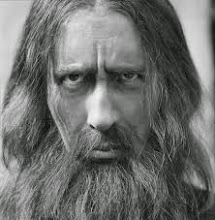


 Repent or Die